


Page 21 - Ranger SPM 2022 Biology
P. 21
Biology SPM  Chapter 2 Leaf Structure and Function

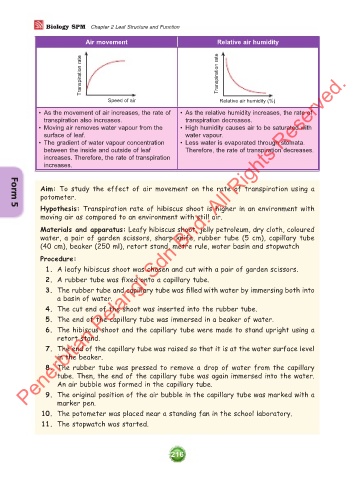
                             Air movement                        Relative air humidity
                            Transpiration rate                   Transpiration rate

             Penerbitan Pelangi Sdn Bhd. All Rights Reserved.


                                   Speed of air                   Relative air humidity (%)
                •  As the movement of air increases, the rate of   •  As the relative humidity increases, the rate of
                  transpiration also increases.         transpiration decreases.
                •  Moving air removes water vapour from the   •  High humidity causes air to be saturated with
                  surface of leaf.                      water vapour.
                •  The gradient of water vapour concentration   •  Less water is evaporated through stomata.
                  between the inside and outside of leaf   Therefore, the rate of transpiration decreases.
                  increases. Therefore, the rate of transpiration
                  increases.


                 Aim:  To study the effect of air movement on the rate of transpiration using a
                 potometer.
                 Hypothesis: Transpiration rate of hibiscus shoot is higher in an environment with
         Form 5
                 moving air as compared to an environment with still air.
                 Materials and apparatus: Leafy hibiscus shoot, jelly petroleum, dry cloth, coloured
                 water, a pair of garden scissors, sharp knife, rubber tube (5 cm), capillary tube
                 (40 cm), beaker (250 ml), retort stand, metre rule, water basin and stopwatch
                 Procedure:
                   1.  A leafy hibiscus shoot was chosen and cut with a pair of garden scissors.
                   2.  A rubber tube was fixed onto a capillary tube.
                   3.  The rubber tube and capillary tube was filled with water by immersing both into
                     a basin of water.
                   4.  The cut end of the shoot was inserted into the rubber tube.
                   5.  The end of the capillary tube was immersed in a beaker of water.
                   6.  The hibiscus shoot and the capillary tube were made to stand upright using a
                     retort stand.
                   7.  The end of the capillary tube was raised so that it is at the water surface level
                     in the beaker.
                   8.  The rubber tube was pressed to remove a drop of water from the capillary
                     tube. Then, the end of the capillary tube was again immersed into the water.
                     An air bubble was formed in the capillary tube.
                   9.  The original position of the air bubble in the capillary tube was marked with a
                     marker pen.
                  10.  The potometer was placed near a standing fan in the school laboratory.
                  11.  The stopwatch was started.


                                                    216


         F5 Chapter 2.indd   216                                                              3/29/22   4:35 PM

