


Page 12 - Q & A STPM 2022 Biology
P. 12
Biology STPM  Chapter 3 Membrane Structure and Transport

              Question 10
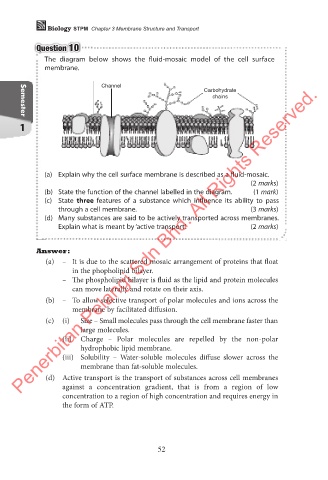
                The diagram below shows the fluid-mosaic model of the cell surface
                membrane.

          Penerbitan Pelangi Sdn Bhd. All Rights Reserved.
                               Channel
                                                          Carbohydrate
                                                            chains

          Semester
          1


                (a)  Explain why the cell surface membrane is described as a fluid-mosaic.
                                                                      (2 marks)
                (b)  State the function of the channel labelled in the diagram.   (1 mark)
                (c)  State  three features of a substance which influence its ability to pass
                    through a cell membrane.                           (3 marks)
                (d)  Many substances are said to be actively transported across membranes.
                    Explain what is meant by ‘active transport’.       (2 marks)


              Answer :
                 (a)  –  It is due to the scattered mosaic arrangement of proteins that float
                        in the phopholipid bilayer.
                     –  The phospholipid bilayer is fluid as the lipid and protein molecules
                        can move laterally and rotate on their axis.
                 (b)  –  To allow selective transport of polar molecules and ions across the
                        membrane by facilitated diffusion.
                 (c)  (i)   Size – Small molecules pass through the cell membrane faster than
                          large molecules.
                     (ii)  Charge – Polar molecules are repelled by the non-polar
                          hydrophobic lipid membrane.
                     (iii)  Solubility  –  Water-soluble  molecules  diffuse  slower  across  the
                          membrane than fat-soluble molecules.
                 (d)  Active transport is the transport of substances across cell membranes
                     against a concentration gradient, that is from a region of low
                     concentration to a region of high concentration and requires energy in
                     the form of ATP.


                                              52


         Chapter 3.indd   52                                                   11/2/21   9:21 AM

