


Page 25 - Focus SPM KSSM F4 2020 - Chemistry
P. 25
Chemistry Form 4  Chapter 3 The Mole Concept, Chemical Formula and Equation
          5.  The state symbols (s), (l) and (g) represent the solid, liquid and gaseous states respectively. The symbol
            (aq) represents the aqueous solution.
                                             SPM Tips

         Many students are not able to balance equations. You only need to adjust the coefficients in front of the formulae.
         Never adjust the subscript numbers in the formulae because this will change the chemical formulae of the
         substances. Balance all types of atoms, one at a time. Practice balancing equations regularly so that you can
         master it.

               ACTIVITY      3.3


         Aim :  To construct balanced chemical equations.
         Materials : Copper(II) carbonate powder, limewater, concentrated hydrochloric acid, concentrated
                    ammonia solution, lead(II) nitrate solution and potassium iodide solution.
         Apparatus :  Test tubes, stoppers, delivery tubes with rubber bung, test tube holder, Bunsen burner and   Chapter
                    glass tube.
         Procedure:                                                                                   3
          A   Heating of copper(II) carbonate
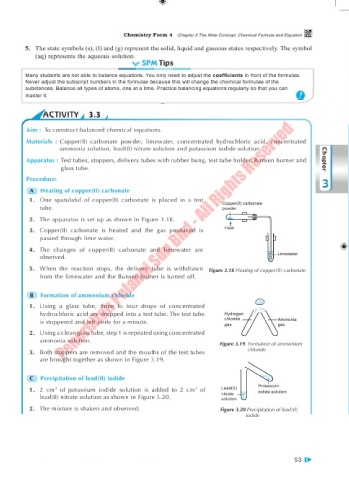
           1.  One  spatulaful of copper(II) carbonate is placed in a test   Copper(II) carbonate
              tube.                                                   powder
           2.   The apparatus is set up as shown in Figure 3.18.
           3.   Copper(II) carbonate is heated and the gas produced is   Heat
              passed through lime water.
           4.   The changes of copper(II) carbonate and limewater are
              observed.                                                                 Limewater
           5.   When the reaction stops, the delivery tube is withdrawn  Figure 3.18 Heating of copper(II) carbonate
              from the limewater and the Bunsen burner is turned off.


          B   Formation of ammonium chloride
           1.  Using  a glass tube, three to four drops of concentrated
              hydrochloric acid are dropped into a test tube. The test tube   Hydrogen
              is stoppered and left aside for a minute.                chloride         Ammonia
                                                                       gas              gas
           2.   Using a clean glass tube, step 1 is repeated using concentrated
              ammonia solution.
                                                                      Figure 3.19  Formation of ammonium
           3.   Both stoppers are removed and the mouths of the test tubes      chloride
              are brought together as shown in Figure 3.19.


          C   Precipitation of lead(II) iodide
           1.  2 cm  of  potassium iodide solution is added to 2 cm  of   Lead(II)  Potassium
                                                              3
                  3
                                                                                  iodide solution
              lead(II) nitrate solution as shown in Figure 3.20.      nitrate
                                                                      solution
           2.   The mixture is shaken and observed.                   Figure 3.20 Precipitation of lead(II)
                                                                              iodide


                                                                                             53


 03 SPM CHEMISTRY F4.indd   53                                                               27/02/2020   11:23 AM

