


Page 12 - Focus PT3 2020 Science ( BI Version )
P. 12
Science PT3  Chapter 2  Cell as the Basic Unit of Life
             The Types and Functions  of Animal Cells and Plant Cells

                                                                                    N
                                                                                  E
                                                                                    N
                                                                                    N
                                                                                     C
                                                                                     C
                                                                                    N
                                                                                     C
                                                                                SC
                                                                                SCIENCE INFO
                                                                                SC
                                                                                SC
                                                                                  E
                                                                                  E
                                                                                SC
                                                                                  E
                                                                                     C
                                                                                      E
                                                                                      E
                                                                                        INFO
                                                                                        INFO
               1.  Humans, animals and plants are multicellular organisms in    SC I I I I I E                           N C E  INFO
                                                                                        INFO
                                                                                      E INFO
                                                                                SCIENCE INFO
                                                                                        INFO
                                                                                        INFO
                                                                                        INFO
                                                                                      E INFO
                                                                                        INFO
                                                                                        INFO
                                                                                        INFO
                 large size, and they are made up of different types of cells for
                 various life processes.                                        Humans are made up of      Form
                                                                                more than 50 trillion
               2.  These cells have different shapes and structures to carry out   (50 000 000 000 000) cells.
                                                                                               Form
                 different functions. They are called specialised cells.                                   1
                 Specialised cells  are cells that have become differentiated to carry out a particular function.
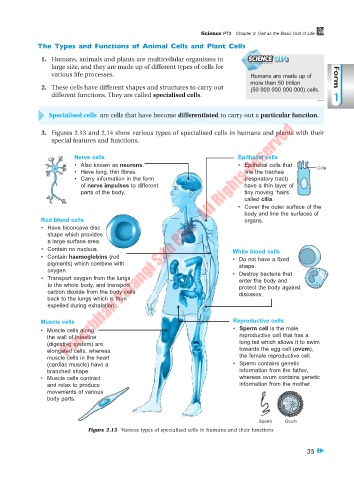
               3.  Figures 2.13 and 2.14 show various types of specialised cells in humans and plants with their
                 special features and functions.
                         Nerve cells                                        Epithelial cells
                         •  Also known as neurons.                          •  Epithelial cells that
                         •  Have long, thin fibres.                           line the trachea        Cilia
                         •  Carry information in the form                     (respiratory tract)
                           of nerve impulses to different                     have a thin layer of
                           parts of the body.                                 tiny moving ‘hairs’
                                                                              called cilia.
                                                                            •  Cover the outer surface of the
                                                                              body and line the surfaces of
              Red blood cells                                                 organs.
              •  Have biconcave disc
                shape which provides
                a large surface area.
              •  Contain no nucleus.                                       White blood cells
              •  Contain haemoglobins (red                                 •  Do not have a fixed
                pigments) which combine with                                 shape.
                oxygen.                                                    •  Destroy bacteria that
              •  Transport oxygen from the lungs                             enter the body and
                to the whole body, and transport                             protect the body against
                carbon dioxide from the body cells                           diseases.
                back to the lungs which is then
                expelled during exhalation.
              Muscle cells                                                 Reproductive cells
              •  Muscle cells along                                        •  Sperm cell is the male
                the wall of intestine                                        reproductive cell that has a
                (digestive system) are                                       long tail which allows it to swim
                elongated cells, whereas                                     towards the egg cell (ovum),
                muscle cells in the heart                                    the female reproductive cell.
                (cardiac muscle) have a                                    •  Sperm contains genetic
                branched shape.                                              information from the father,
              •  Muscle cells contract                                       whereas ovum contains genetic
                and relax to produce                                         information from the mother.
                movements of various
                body parts.
                                                                                   Sperm   Ovum
                             Figure 2.13  Various types of specialised cells in humans and their functions
                                                                                                  35


     02 Fokus Science F1.indd   35                                                                  11/19/19   11:41 AM

