


Page 54 - Buletin JSKM 2021
P. 54
53


                               EVOLUTION OF INTERNET AND THE FUTURE OF IOT
                   Syarifah Adilah Mohamed Yusoff, Mohd Saiful Nizam Abu Bakar, Saiful Nizam Warris

                Modern internet starts when ARPANET adopted TCP/IP in 1983. This set of communication
                protocols were evolved when researchers all around the world began to assemble “network of
                networks”, by incorporate new strategies and topologies such as Local Area Network (LAN)
                to improve these co-called internet. In 1991, Computer Scientist, Tim Berner-Lee has launched
                world wide web (WWW) that merge the techniques of information retrieval with hypertext to
                create an easy but powerful global information system. Starting with the first browser and web
                pages, the prospect of online world growth from the basic of information sharing via accessing
                data online in form of websites and hyperlinks.

                The Web technology moves and growth steadily with computers hardware and commercial
                Internet Service Provider (ISP) that happen to be ubiquitous outside scientific domain and
                immerse inside social community in every aspect of life.  These emerging technologies have
                become part of our daily life which people use at office, home, on the move, on phones or tv.
                Today, the internet has been the key factor that transform the way of communication among
                world community.

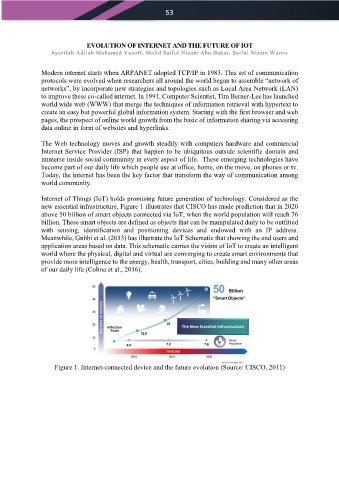
                Internet of Things (IoT) holds promising future generation of technology. Considered as the
                new essential infrastructure, Figure 1 illustrates that CISCO has made prediction that in 2020
                above 50 billion of smart objects connected via IoT, when the world population will reach 76
                billion. These smart objects are defined as objects that can be manipulated daily to be outfitted
                with  sensing,  identification  and  positioning  devices  and  endowed  with  an  IP  address.
                Meanwhile, Gubbi et al. (2013) has illustrate the IoT Schematic that showing the end users and
                application areas based on data. This schematic carries the vision of IoT to create an intelligent
                world where the physical, digital and virtual are converging to create smart environments that
                provide more intelligence to the energy, health, transport, cities, building and many other areas
                of our daily life (Colina et al., 2016).


                    Figure 1. Internet-connected device and the future evolution (Source: CISCO, 2011)

