


Page 55 - Buletin JSKM 2021
P. 55
54


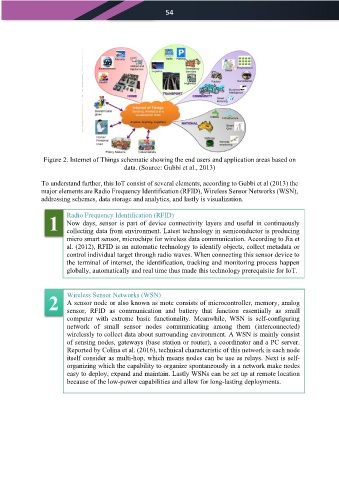
                Figure 2. Internet of Things schematic showing the end users and application areas based on
                                             data. (Source: Gubbi et al., 2013)

                To understand further, this IoT consist of several elements, according to Gubbi et al (2013) the
                major elements are Radio Frequency Identification (RFID), Wireless Sensor Networks (WSN),
                addressing schemes, data storage and analytics, and lastly is visualization.

                  1     Radio Frequency Identification (RFID)
                        Now days, sensor is part of device connectivity layers and useful in continuously
                        collecting data from environment. Latest technology in semiconductor is producing
                        micro smart sensor, microchips for wireless data communication. According to Jia et
                        al. (2012), RFID is an automatic technology to identify objects, collect metadata or
                        control individual target through radio waves. When connecting this sensor device to
                        the terminal of internet, the identification, tracking and monitoring process happen
                        globally, automatically and real time thus made this technology prerequisite for IoT.


                  2      Wireless Sensor Networks (WSN)
                         A sensor node or also known as mote consists of microcontroller, memory, analog
                         sensor,  RFID  as  communication  and  battery  that  function  essentially  as  small
                         computer  with  extreme  basic  functionality.  Meanwhile,  WSN  is  self-configuring
                         network  of  small  sensor  nodes  communicating  among  them  (interconnected)
                         wirelessly to collect data about surrounding environment. A WSN is mainly consist
                         of sensing nodes, gateways (base station or router), a coordinator and a PC server.
                         Reported by Colina et al. (2016), technical characteristic of this network is each node
                         itself consider as multi-hop, which means nodes can be use as relays. Next is self-
                         organizing which the capability to organize spontaneously in a network make nodes
                         easy to deploy, expand and maintain. Lastly WSNs can be set up at remote location
                         because of the low-power capabilities and allow for long-lasting deployments.

