


Page 146 - The Design Thinking Playbook
P. 146
What characterizes an interdisciplinary team?   As mentioned, Peter wants to rely on the in-depth and broadly based
                                                                                     knowledge of his teams. This idea is based on the principle of so-
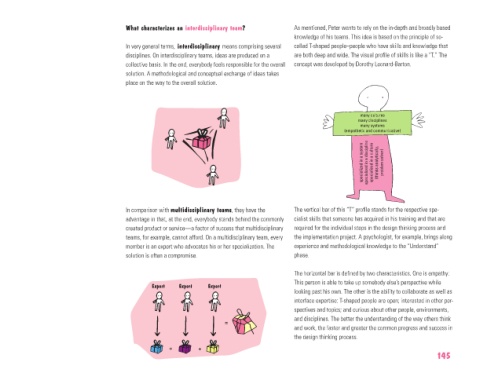
                                     In very general terms, interdisciplinary means comprising several   called T-shaped people–people who have skills and knowledge that
                                     disciplines. On interdisciplinary teams, ideas are produced on a   are both deep and wide. The visual profile of skills is like a “T.” The
                                     collective basis. In the end, everybody feels responsible for the overall   concept was developed by Dorothy Leonard-Barton.
                                     solution. A methodological and conceptual exchange of ideas takes
                                     place on the way to the overall solution.


                                                                                                        many cultures
                                                                                                       many disciplines
                                                                                                        many systems
                                                                                                   (empathetic and communicative)

                                                                                                         specialized in a system  specialized in a discipline  specialized in a culture  (thinks analytically,  problem solver)


                                     In comparison with multidisciplinary teams, they have the   The vertical bar of this “T” profile stands for the respective spe-
                                     advantage in that, at the end, everybody stands behind the commonly   cialist skills that someone has acquired in his training and that are
                                     created product or service—a factor of success that multidisciplinary   required for the individual steps in the design thinking process and
                                     teams, for example, cannot afford. On a multidisciplinary team, every   the  implementation project. A psychologist, for example, brings along
                                     member is an expert who advocates his or her specialization. The     experience and methodological knowledge to the “Understand”
                                     solution is often a compromise.                 phase.

                                                                                     The horizontal bar is defined by two characteristics. One is empathy:
                                                                                     This person is able to take up somebody else’s perspective while
                                            Expert  Expert  Expert
                                                                                     looking past his own. The other is the ability to collaborate as well as
                                                                                     interface expertise: T-shaped people are open; interested in other per-
                                                                                     spectives and topics; and curious about other people, environments,
                                                                                     and disciplines. The better the understanding of the way others think
                                                                 =
                                                                                     and work, the faster and greater the common progress and success in
                                                                                     the design thinking process.
                                                 +        +
                                                                                                                              145

