


Page 145 - The Design Thinking Playbook
P. 145
2.2 What are the benefits of interdisciplinary teams?


         Peter collaborates with different teams in his projects. To be success-
         ful, he emphasizes two dimensions: The team members must have
         in-depth technical knowledge as well as a broad general knowledge.
         For Lilly’s students, it is a wonderful feeling when they have finally ad-
         vanced a step with their own question and gotten out of a deadlock.
         It often occurs because the participants have asked others for advice.
         Regarding the same problem from a different perspective often helps
         find a way out of a dead end.
         With many problem statements, there are limits to how much your
         own skills can contribute to the solution of the problem. The reason
         for this is usually a lack of knowhow and experience in a specific
         subject area. No later than this point, the design team must consult
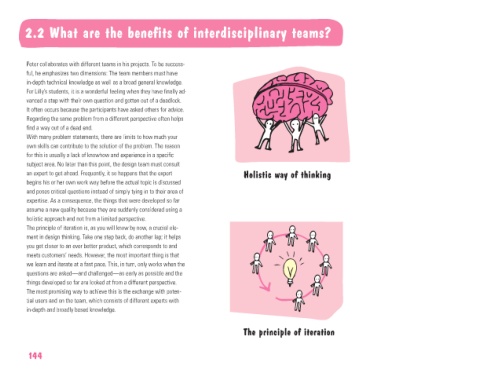
         an expert to get ahead. Frequently, it so happens that the expert   Holistic way of thinking
         begins his or her own work way before the actual topic is discussed
         and poses critical questions instead of simply tying in to their area of
         expertise. As a consequence, the things that were developed so far
         assume a new quality because they are suddenly considered using a
         holistic approach and not from a limited perspective.
         The principle of iteration is, as you will know by now, a crucial ele-
         ment in design thinking. Take one step back, do another lap; it helps
         you get closer to an ever better product, which corresponds to and
         meets customers’ needs. However, the most important thing is that
         we learn and iterate at a fast pace. This, in turn, only works when the
         questions are asked—and challenged—as early as possible and the
         things developed so far are looked at from a different perspective.
         The most promising way to achieve this is the exchange with poten-
         tial users and on the team, which consists of different experts with
         in-depth and broadly based knowledge.

                                                                       The principle of iteration


         144

