


Page 19 - The Design Thinking Playbook
P. 19
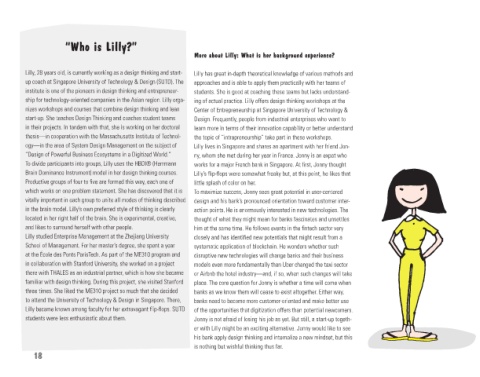
“Who is Lilly?”
                                                        More about Lilly: What is her background experience?

        Lilly, 28 years old, is currently working as a design thinking and start-  Lilly has great in-depth theoretical knowledge of various methods and
        up coach at Singapore University of Technology & Design (SUTD). The   approaches and is able to apply them practically with her teams of
        institute is one of the pioneers in design thinking and entrepreneur-  students. She is good at coaching these teams but lacks understand-
        ship for technology-oriented companies in the Asian region. Lilly orga-  ing of actual practice. Lilly offers design thinking workshops at the
        nizes workshops and courses that combine design thinking and lean   Center of Entrepreneurship at Singapore University of Technology &
        start-up. She teaches Design Thinking and coaches student teams   Design. Frequently, people from industrial enterprises who want to
        in their projects. In tandem with that, she is working on her doctoral   learn more in terms of their innovation capability or better understand
        thesis—in cooperation with the Massachusetts Institute of Technol-  the topic of “intrapreneurship” take part in these workshops.
        ogy—in the area of System Design Management on the subject of   Lilly lives in Singapore and shares an apartment with her friend Jon-
        “Design of Powerful Business Ecosystems in a Digitized World.”   ny, whom she met during her year in France. Jonny is an expat who
        To divide participants into groups, Lilly uses the HBDI® (Herrmann   works for a major French bank in Singapore. At first, Jonny thought
        Brain Dominance Instrument) model in her design thinking courses.   Lilly’s flip-flops were somewhat freaky but, at this point, he likes that
        Productive groups of four to five are formed this way, each one of   little splash of color on her.
        which works on one problem statement. She has discovered that it is   To maximize success, Jonny sees great potential in user-centered
        vitally important in each group to unite all modes of thinking described   design and his bank’s pronounced orientation toward customer inter-
        in the brain model. Lilly’s own preferred style of thinking is clearly   action points. He is enormously interested in new technologies. The
        located in her right half of the brain. She is experimental, creative,   thought of what they might mean for banks fascinates and unsettles
        and likes to surround herself with other people.   him at the same time. He follows events in the fintech sector very
        Lilly studied Enterprise Management at the Zhejiang University   closely and has identified new potentials that might result from a
        School of Management. For her master’s degree, she spent a year   systematic application of blockchain. He wonders whether such
        at the École des Ponts ParisTech. As part of the ME310 program and   disruptive new technologies will change banks and their business
        in collaboration with Stanford University, she worked on a project   models even more fundamentally than Uber changed the taxi sector
        there with THALES as an industrial partner, which is how she became   or Airbnb the hotel industry—and, if so, when such changes will take
        familiar with design thinking. During this project, she visited Stanford   place. The core question for Jonny is whether a time will come when
        three times. She liked the ME310 project so much that she decided   banks as we know them will cease to exist altogether. Either way,
        to attend the University of Technology & Design in Singapore. There,   banks need to become more customer-oriented and make better use
        Lilly became known among faculty for her extravagant flip-flops. SUTD   of the opportunities that digitization offers than potential newcomers.
        students were less enthusiastic about them.     Jonny is not afraid of losing his job as yet. But still, a start-up togeth-
                                                        er with Lilly might be an exciting alternative. Jonny would like to see
                                                        his bank apply design thinking and internalize a new mindset, but this
                                                        is nothing but wishful thinking thus far.
           18

