


Page 22 - The Design Thinking Playbook
P. 22
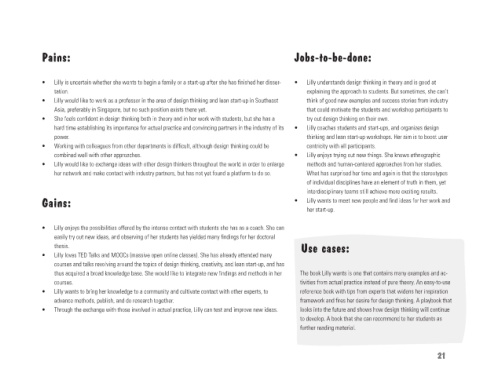
Pains:                                                                  Jobs-to-be-done:


             •   Lilly is uncertain whether she wants to begin a family or a start-up after she has finished her disser-  •   Lilly understands design thinking in theory and is good at
                 tation.                                                                 explaining the approach to students. But sometimes, she can’t
             •   Lilly would like to work as a professor in the area of design thinking and lean start-up in Southeast   think of good new examples and success stories from industry
                 Asia, preferably in Singapore, but no such position exists there yet.   that could motivate the students and workshop participants to
             •   She feels confident in design thinking both in theory and in her work with students, but she has a   try out design thinking on their own.
                 hard time establishing its importance for actual practice and convincing partners in the industry of its   •   Lilly coaches students and start-ups, and organizes design
                 power.                                                                  thinking and lean start-up workshops. Her aim is to boost user
             •   Working with colleagues from other departments is difficult, although design thinking could be   centricity with all participants.
                 combined well with other approaches.                                •   Lilly enjoys trying out new things. She knows ethnographic
             •   Lilly would like to exchange ideas with other design thinkers throughout the world in order to enlarge   methods and human-centered approaches from her studies.
                 her network and make contact with industry partners, but has not yet found a platform to do so.  What has surprised her time and again is that the stereotypes
                                                                                         of individual disciplines have an element of truth in them, yet
                                                                                         interdisciplinary teams still achieve more exciting results.
             Gains:                                                                  •   Lilly wants to meet new people and find ideas for her work and
                                                                                         her start-up.

             •   Lilly enjoys the possibilities offered by the intense contact with students she has as a coach. She can
                 easily try out new ideas, and observing of her students has yielded many findings for her doctoral
                 thesis.                                                               Use cases:
             •   Lilly loves TED Talks and MOOCs (massive open online classes). She has already attended many
                 courses and talks revolving around the topics of design thinking, creativity, and lean start-up, and has
                 thus acquired a broad knowledge base. She would like to integrate new findings and methods in her   The book Lilly wants is one that contains many examples and ac-
                 courses.                                                              tivities from actual practice instead of pure theory. An easy-to-use
             •   Lilly wants to bring her knowledge to a community and cultivate contact with other experts, to   reference book with tips from experts that widens her inspiration
                 advance methods, publish, and do research together.                   framework and fires her desire for design thinking. A playbook that
             •   Through the exchange with those involved in actual practice, Lilly can test and improve new ideas.  looks into the future and shows how design thinking will continue
                                                                                       to develop. A book that she can recommend to her students as
                                                                                       further reading material.


                                                                                                                              21

