


Page 213 - The Design Thinking Playbook
P. 213
3.1 Why systems thinking helps to understand complexity


        We begin our chapter on designing the future with systems thinking, although the approach and the mind-  Engineered systems have a reason for their existence: They imple-
        set are at least as old as the design thinking paradigm. We are firmly convinced, though, that the basic   ment a desired or required function. For example, we want to build
        conditions and interaction of systems must be taken into account more and more when we develop our   a self-driving car for a stress-free drive from point A to point B. As
        future products, services, and business ecosystems. The use of a converging mindset of systems thinking   an alternative, we can integrate the autonomous vehicle in a system
        and design thinking will be pivotal in many areas.                       of means of transportation and won’t ever again have to search for
        The last time Peter dealt with systems engineering was during his time as a student at Munich Technical   a parking space, because the vehicle will be permanently be on the
        University. He can recall quite well a discussion during a lecture in the context of the Challenger explosion   road as part of a larger system. For this, the responses from certain
        on January 28, 1986. It was determined at the time that the system had not been adapted to safety needs,   sensors and information in the vehicle are important for communicat-
        and this was why the terrible disaster occurred. Peter often thinks about the disaster. How complex are   ing the necessary parameters to the system on how it must adapt to
        things when a self-driving car is on the road? How many systems must interact with one another?  its environment. A rain and cold sensor, for instance, in combination
                                                                                 with a camera or radar can provide information on road conditions
                                                                                 and thus be an indicator for the speed to be chosen. To achieve this,
                                                                                 all components must interact. With regard to self-contained technical
                                                                                 systems, complexity is manageable. But as soon as nature as such
                                                                                 and our social systems come into play, forecasts are far more difficult.
                                                                                 Traffic will increase when we no longer park our autonomous vehicles
                                                                                 but have them circulate in the cities. It’s our own motives in a system
                                                                                 that are difficult to explore and comprehend.

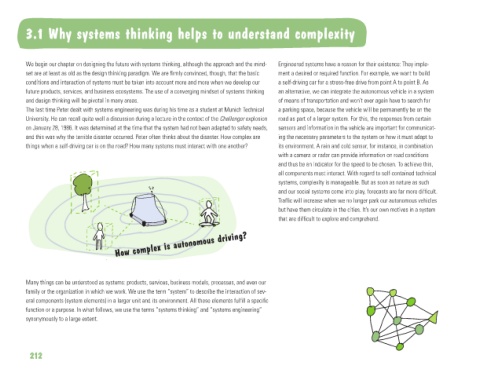
                                  How complex is autonomous driving?


        Many things can be understood as systems: products, services, business models, processes, and even our
        family or the organization in which we work. We use the term “system” to describe the interaction of sev-
        eral components (system elements) in a larger unit and its environment. All these elements fulfill a specific
        function or a purpose. In what follows, we use the terms “systems thinking” and “systems engineering”
        synonymously to a large extent.


          212

