


Page 216 - The Design Thinking Playbook
P. 216
What are the elements a systems thinking process consists of?


                                     Put simply, systems thinking is another problem-solving method that uses a variety of elements to optimize
                                     the system.
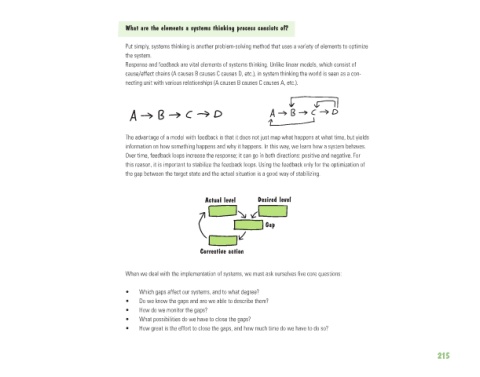
                                     Response and feedback are vital elements of systems thinking. Unlike linear models, which consist of
                                     cause/effect chains (A causes B causes C causes D, etc.), in system thinking the world is seen as a con-
                                     necting unit with various relationships (A causes B causes C causes A, etc.).


                                     The advantage of a model with feedback is that it does not just map what happens at what time, but yields
                                     information on how something happens and why it happens. In this way, we learn how a system behaves.
                                     Over time, feedback loops increase the response; it can go in both directions: positive and negative. For
                                     this reason, it is important to stabilize the feedback loops. Using the feedback only for the optimization of
                                     the gap between the target state and the actual situation is a good way of stabilizing.


                                                            Actual level   Desired level


                                                                             Gap


                                                          Corrective action


                                     When we deal with the implementation of systems, we must ask ourselves five core questions:


                                     •   Which gaps affect our systems, and to what degree?
                                     •   Do we know the gaps and are we able to describe them?
                                     •   How do we monitor the gaps?
                                     •   What possibilities do we have to close the gaps?
                                     •   How great is the effort to close the gaps, and how much time do we have to do so?


                                                                                                                              215

