


Page 217 - The Design Thinking Playbook
P. 217
How does systems thinking work?


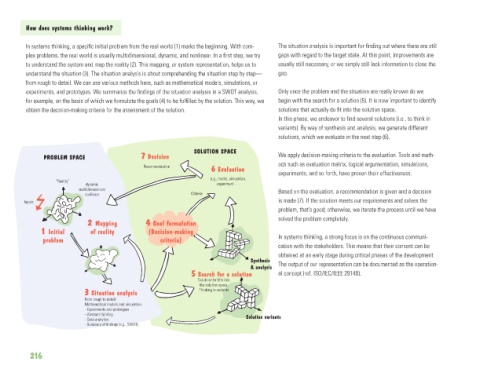
        In systems thinking, a specific initial problem from the real world (1) marks the beginning. With com-  The situation analysis is important for finding out where there are still
        plex problems, the real world is usually multidimensional, dynamic, and nonlinear. In a first step, we try   gaps with regard to the target state. At this point, improvements are
        to understand the system and map the reality (2). This mapping, or system representation, helps us to   usually still necessary, or we simply still lack information to close the
        understand the situation (3). The situation analysis is about comprehending the situation step by step—  gap.
        from rough to detail. We can use various methods here, such as mathematical models, simulations, or
        experiments, and prototypes. We summarize the findings of the situation analysis in a SWOT analysis,   Only once the problem and the situation are really known do we
        for example, on the basis of which we formulate the goals (4) to be fulfilled by the solution. This way, we   begin with the search for a solution (5). It is now important to identify
        obtain the decision-making criteria for the assessment of the solution.  solutions that actually do fit into the solution space.
                                                                                 In this phase, we endeavor to find several solutions (i.e., to think in
                                                                                 variants). By way of synthesis and analysis, we generate different
                                                                                 solutions, which we evaluate in the next step (6).
                                                        SOLUTION SPACE
             PROBLEM SPACE               7 Decision                              We apply decision-making criteria to the evaluation. Tools and meth-
                                                                                 ods such as evaluation matrix, logical argumentation, simulations,
                                          Recommendation
                                                             6 Evaluation
                                                                                 experiments, and so forth, have proven their effectiveness.
                                                             e.g., model, simulation,
                 “Reality”
                          dynamic                              experiment . . .
                        multidimensional                                         Based on the evaluation, a recommendation is given and a decision
                         nonlinear                      Criteria
        Inputs                                                                   is made (7). If the solution meets our requirements and solves the
                                                                                 problem, that’s good; otherwise, we iterate the process until we have
                                                                                 solved the problem completely.
                          2 Mapping        4 Goal formulation
             1 Initial     of reality      (Decision-making
             problem                           criteria)                         In systems thinking, a strong focus is on the continuous communi-
                                                                                 cation with the stakeholders. This means that their consent can be
                                                                                 obtained at an early stage during critical phases of the development.
                                                                         Synthesis   The output of our representation can be documented as the operation-
                                                                         & analysis
                                                        5 Search for a solution  al concept (ref. ISO/IEC/IEEE 29148).
                                                          Solution that fits into
                                                          the solution space.
                         3 Situation analysis             Thinking in variants
                         From rough to detail
                         Mathematical models and simulation
                         - Experiments and prototypes
                         - Abstract thinking
                         - Data analytics                              Solution variants
                         - Summary of findings (e.g., SWOT)


          216

