


Page 220 - The Design Thinking Playbook
P. 220
HOW MIGHT WE...
                          use systems thinking in design thinking?


             We don’t want to get into philosophical speculations here as to whether design thinking is superimposed
             on systems thinking or whether the processes should be ranked in a hierarchy. From our experience, it is
             best when design thinking and systems thinking complement each other as the situation requires it.

             If we take a typical development process as a basis, we can assume that design thinking is a strong tool
             in an early phase (conception and feasibility). This is especially true when the issue is simple functional-
             ities or the interaction with a potential user. For the interaction of components, the simulation of complex
             processes, or the engineering of requirements, systems thinking is predestined for many developments.

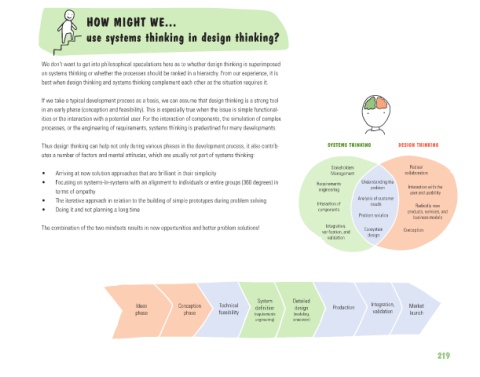
             Thus design thinking can help not only during various phases in the development process, it also contrib-  SYSTEMS THINKING  DESIGN THINKING
             utes a number of factors and mental attitudes, which are usually not part of systems thinking:
                                                                                                Stakeholders          Radical
             •   Arriving at new solution approaches that are brilliant in their simplicity     Management           collaboration
             •   Focusing on systems-in-systems with an alignment to individuals or entire groups (360 degrees) in   Requirements  Understanding the
                 terms of empathy                                                           engineering    problem    Interaction with the
                                                                                                                      user and usability
             •   The iterative approach in relation to the building of simple prototypes during problem solving  Interaction of  Analysis of customer
                                                                                                           needs
                                                                                                                        Radically new
             •   Doing it and not planning a long time                                      components                products, services, and
                                                                                                        Problem solution  business models
             The combination of the two mindsets results in new opportunities and better problem solutions!  Integration,   Ecosystem
                                                                                             verification, and   design  Conception
                                                                                               validation


                                                                           System    Detailed
                                        Ideas       Conception  Technical  definition  design   Production  Integration,  Market
                                        phase        phase      feasibility  (requirements  (modeling,      validation  launch
                                                                          engineering)  simulation)


                                                                                                                              219

