


Page 271 - The Design Thinking Playbook
P. 271
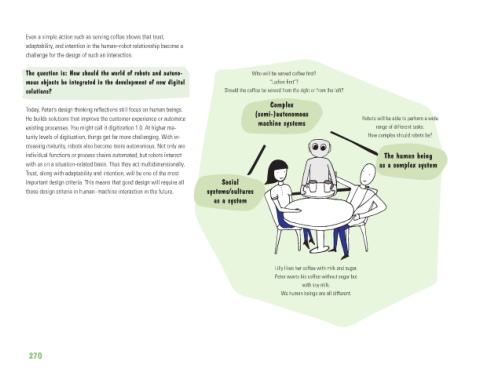
Even a simple action such as serving coffee shows that trust,
        adaptability, and intention in the human–robot relationship become a
        challenge for the design of such an interaction.

        The question is: How should the world of robots and autono-      Who will be served coffee first?
        mous objects be integrated in the development of new digital          “Ladies first”?
        solutions?                                               Should the coffee be served from the right or from the left?
                                                                              Complex
        Today, Peter’s design thinking reflections still focus on human beings.   (semi-)autonomous
        He builds solutions that improve the customer experience or automate   machine systems           Robots will be able to perform a wide
        existing processes. You might call it digitization 1.0. At higher ma-                               range of different tasks.
        turity levels of digitization, things get far more challenging. With in-                          How complex should robots be?
        creasing maturity, robots also become more autonomous. Not only are
        individual functions or process chains automated, but robots interact                                  The human being
        with us on a situation-related basis. Thus they act multidimensionally.                              as a complex system
        Trust, along with adaptability and intention, will be one of the most
        important design criteria. This means that good design will require all   Social
        these design criteria in human–machine interaction in the future.   systems/cultures
                                                              as a system


                                                                                Lilly likes her coffee with milk and sugar.
                                                                                Peter wants his coffee without sugar but
                                                                                       with soy milk.
                                                                                 We human beings are all different.


         270

