


Page 268 - The Design Thinking Playbook
P. 268
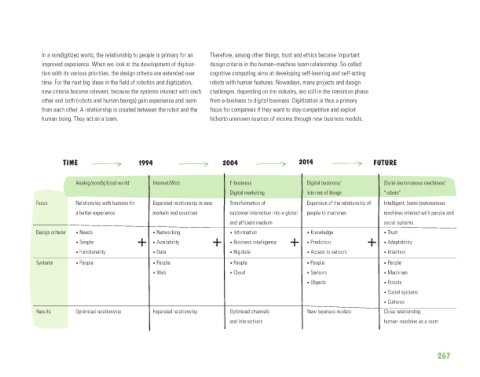
In a nondigitized world, the relationship to people is primary for an   Therefore, among other things, trust and ethics become important
             improved experience. When we look at the development of digitiza-  design criteria in the human–machine team relationship. So-called
             tion with its various priorities, the design criteria are extended over   cognitive computing aims at developing self-learning and self-acting
             time. For the next big ideas in the field of robotics and digitization,   robots with human features. Nowadays, many projects and design
             new criteria become relevant, because the systems interact with each   challenges, depending on the industry, are still in the transition phase
             other and both (robots and human beings) gain experience and learn   from e-business to digital business. Digitization is thus a primary
             from each other. A relationship is created between the robot and the   focus for companies if they want to stay competitive and exploit
             human being. They act as a team.                hitherto unknown sources of income through new business models.


                   TIME                  1994                    2004                 2014                  FUTURE


                       Analog/nondigitized world  Internet/Web     E-business            Digital business/     (Semi-)autonomous machines/
                                                                   Digital marketing     Internet of things    “robots”
           Focus       Relationship with humans for   Expanded relationship in new   Transformation of   Expansion of the relationship of   Intelligent, (semi-)autonomous
                       a better experience   markets and countries  customer interaction into a global   people to machines  machines interact with people and
                                                                   and efficient medium                        social systems
           Design criteria  • Needs          • Networking          • Information         • Knowledge           • Trust
                       • Simple              • Availability        • Business intelligence  • Prediction       • Adaptability
                       • Functionality       • Data                • Big data            • Access to sensors   • Intention
           Systems     • People              • People              • People              • People              • People
                                             • Web                 • Cloud               • Sensors             • Machines
                                                                                         • Objects             • Robots
                                                                                                               • Social systems
                                                                                                               • Cultures
           Results     Optimized relationship  Expanded relationship  Optimized channels   New business models  Close relationship,
                                                                   and interactions                            human–machine as a team


                                                                                                                              267

