


Page 272 - The Design Thinking Playbook
P. 272
Peter has a new design challenge that he wants to solve in collab-  New design challenge:
             oration with a university in Switzerland. He’s in contact with the   “How might we design the experience of interaction between drones
             university’s teaching teams. Peter’s design challenge comprises   and humans?”
             finding a solution for registering drones and determining their loca-
             tion. For the most part, today, autonomous drones are not yet out and   Based on this new design challenge, the question is illuminated from
             about. But they are getting increasingly more autonomous and will fly   another side. The result is that the technical solution is put on the
             by themselves in the future. They will perform tasks in the areas of   back burner, while the relationship between man and machine takes
             monitoring, repair, and delivery; render corresponding services; or will   center stage in a more heightened way as the critical design criterion.
             be simply of use in the context of lifestyle applications.    Expanding the design criteria serves as a basis for a solution in which
                                                             everybody can identify drones and, at the same time, can get expand-
             Design challenge:                               ed services from the interaction.
             “How might we design the registration and tracking process of drones
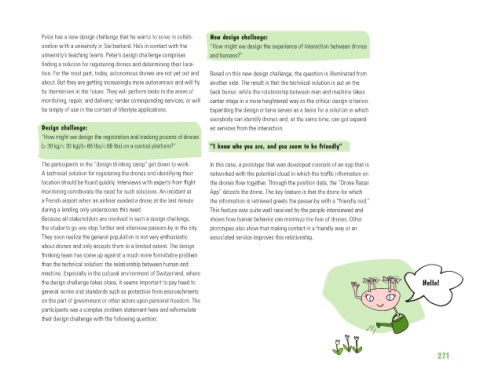
             (> 30 kg/< 30 kg)/(> 66 lbs/< 66 lbs) on a central platform?”   “I know who you are, and you seem to be friendly”


             The participants in the “design thinking camp” get down to work.   In this case, a prototype that was developed consists of an app that is
             A technical solution for registering the drones and identifying their   networked with the potential cloud in which the traffic information on
             location should be found quickly. Interviews with experts from flight   the drones flow together. Through the position data, the “Drone Radar
             monitoring corroborate the need for such solutions. An incident at   App” detects the drone. The key feature is that the drone for which
             a French airport when an airliner evaded a drone at the last minute   the information is retrieved greets the passer-by with a “friendly nod.”
             during a landing only underscores this need.    This feature was quite well received by the people interviewed and
             Because all stakeholders are involved in such a design challenge,   shows how human behavior can minimize the fear of drones. Other
             the students go one step further and interview passers-by in the city.   prototypes also show that making contact in a friendly way or an
             They soon realize the general population is not very enthusiastic   associated service improves this relationship.
             about drones and only accepts them to a limited extent. The design
             thinking team has come up against a much more formidable problem
             than the technical solution: the relationship between human and
             machine. Especially in the cultural environment of Switzerland, where
             the design challenge takes place, it seems important to pay heed to                                          Hello!
             general norms and standards such as protection from encroachments
             on the part of government or other actors upon personal freedom. The
             participants see a complex problem statement here and reformulate
             their design challenge with the following question:


                                                                                                                              271

