


Page 298 - The Design Thinking Playbook
P. 298
EXPERT TIP

                         Use of Social CRM


             With Social CRM (SCRM), we can expand conventional customer
             relationship management using elements that focus on the interaction
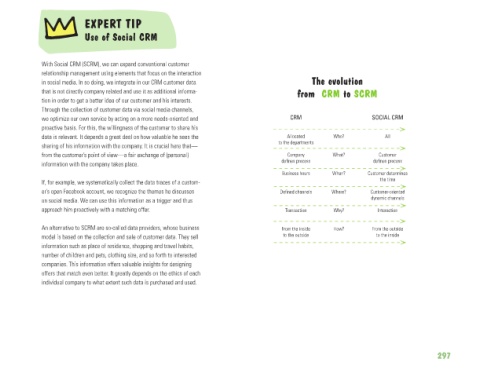
             in social media. In so doing, we integrate in our CRM customer data          The evolution
             that is not directly company related and use it as additional informa-   from  CRM to SCRM
             tion in order to get a better idea of our customer and his interests.
             Through the collection of customer data via social media channels,
             we optimize our own service by acting on a more needs-oriented and     CRM                    SOCIAL CRM
             proactive basis. For this, the willingness of the customer to share his
             data is relevant. It depends a great deal on how valuable he sees the   Allocated  Who?           All
             sharing of his information with the company. It is crucial here that—  to the departments
             from the customer’s point of view—a fair exchange of (personal)       Company      What?        Customer
             information with the company takes place.                            defines process           defines process
                                                                                  Business hours  When?   Customer determines
             If, for example, we systematically collect the data traces of a custom-                          the time
             er’s open Facebook account, we recognize the themes he discusses    Defined channels  Where?  Customer-oriented
             on social media. We can use this information as a trigger and thus                            dynamic channels
             approach him proactively with a matching offer.                       Transaction  Why?         Interaction

             An alternative to SCRM are so-called data providers, whose business   From the inside   How?  From the outside
             model is based on the collection and sale of customer data. They sell   to the outside          to the inside
             information such as place of residence, shopping and travel habits,
             number of children and pets, clothing size, and so forth to interested
             companies. This information offers valuable insights for designing
             offers that match even better. It greatly depends on the ethics of each
             individual company to what extent such data is purchased and used.


                                                                                                                              297

