


Page 303 - The Design Thinking Playbook
P. 303
3.8  How to combine design thinking and data analytics to spur agility


        The job profiles and roles in our companies are changing across the board. There is a multitude of new job
        profiles today. Until recently, Peter thought he had the coolest job in his company. After all, as the Co-
        Creation and Innovation Manager, he shaped the innovations of tomorrow. Then, some time ago, he read
        in the Harvard Business Review that being a data scientist is the “sexiest job in the 21st century.” In the
        future, data scientists will generate innovations, solve problems, satisfy customers, and get to know more
        about the customers’ needs through big data analytics. In his blog on digital transformation, the CEO of
        Peter’s company had also written about a data-driven business  and that, nowadays, all business problems
        are solved with the new technologies.

        How can we take advantage of this trend for our design challenges and integrate the faction
        of data scientists in the problem-solving process?

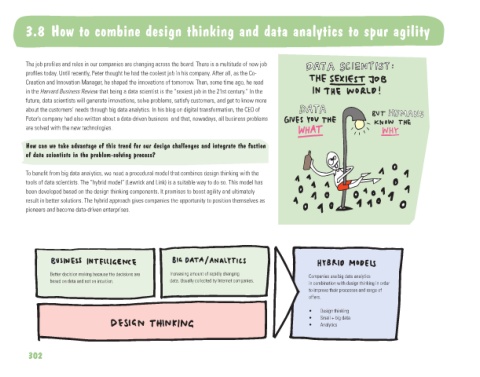
        To benefit from big data analytics, we need a procedural model that combines design thinking with the
        tools of data scientists. The “hybrid model” (Lewrick and Link) is a suitable way to do so. This model has
        been developed based on the design thinking components. It promises to boost agility and ultimately
        result in better solutions. The hybrid approach gives companies the opportunity to position themselves as
        pioneers and become data-driven enterprises.


               Better decision making because the decisions are   Increasing amount of rapidly changing  Companies use big data analytics
               based on data and not on intuition.  data. Usually collected by Internet companies.  in combination with design thinking in order
                                                                                         to improve their processes and range of
                                                                                         offers.

                                                                                         •   Design thinking
                                                                                         •   Small + big data
                                                                                         •   Analytics


         302

