


Page 60 - The Design Thinking Playbook
P. 60
Peter also questions his ideas for improving the quality of his product   It stands to reason that an innovation only works when we have internalized the needs of our users and
             when he is sitting at his desk, doing nothing. When was the last time   developed a thorough understanding of them. It can be achieved when we are where they are, especially
             he saw somebody using his product in daily life? Has he ever stood   when we witness the part of their life we want to improve.
             next to a customer at the exact moment when the customer felt the   If you now think we’ll present even more tools to observe people in their environment, you’re wrong.
             need for the now newly invented function? Not because Peter had   Such tools can help us, but ultimately it is all a matter of one decisive point in needfinding: Find out which
             asked the customer (“Would you like . . .”) but because the customer   assumptions you have made in your mind and become aware of them.
             had searched for this function on his own.
             Such moments give us an insight into the lives of users and indicate   In the everyday work of a company, it is a common phenomenon that innovation managers work on ideas
             where deep and long-term needs are hidden.      that are not based on real needs. Often, when we ask them what doesn’t work in the everyday life of a
                                                             person that would give their ideas real added value, we are met with a blank stare.
             Not knowing the everyday life of people means we continually make   In such cases, it is useless to send out the innovation managers, because they don’t know what they
             assumptions on which we base our decisions. About eight million   should see and hear. So needfinding does not take place in many companies and is inevitably seen as a
             people live in Switzerland. If Priya, who lives in Zurich today, claimed   waste of time and money.
             she knows exactly how the residents in a small village live, then her   Many traditional management and innovation consultants rely on so-called customer interviews conducted
             knowledge is solely based on the experience of her youth when she   not by the consultant himself or a market research institute tasked by him. The consultant then picks and
             lived in a village in India, that was about the same size at that time.   chooses from the interviews only those things that match what he has seen or heard and that fit into the
             Although her experience gives her access to certain aspects of village   reality he has developed over a lifetime. Thus, not infrequently, decisions makers see needfinding as a risk
             life, she is incapable of developing a perfect solution that covers the   to the success of their project.
             majority of needs of villagers in today’s Switzerland.   If we succeed in embodying an attitude of pure curiosity in needfinding, we find that everything we learn
                                                             can guide us to new and even more human-centered solutions.
                                                             In needfinding, we recognize things that still don’t work, maybe that never will work, or that we must
                                                             watch very closely so that, in the end, our innovation meets a need.


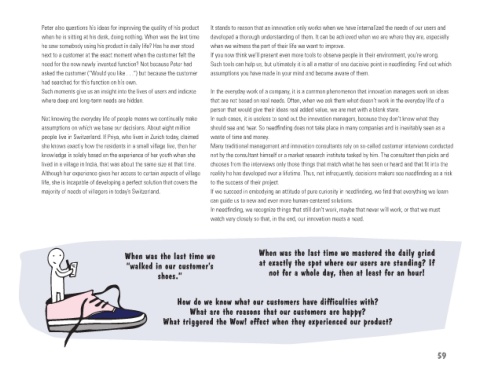
                                     When was the last time we             When was the last time we mastered the daily grind
                                     “walked in our customer’s             at exactly the spot where our users are standing? If
                                              shoes.”                         not for a whole day, then at least for an hour!


                                                    How do we know what our customers have difficulties with?
                                                       What are the reasons that our customers are happy?
                                                What triggered the Wow! effect when they experienced our product?


                                                                                                                              59

