


Page 55 - The Design Thinking Playbook
P. 55
HOW MIGHT WE...

                   start, although the problem is elusive?


        In principle, the ideal starting point is where we leave the comfort zone. To find the right starting point
        based on a problem statement is not very easy. Often the team wonders whether the starting point is
        too narrow or too broad. In such a case, we recommend just starting. If the challenge is too narrowly
        conceived, the team will expand the problem in the first iteration. If the challenge is conceived too broadly,
        the team will narrow it down.

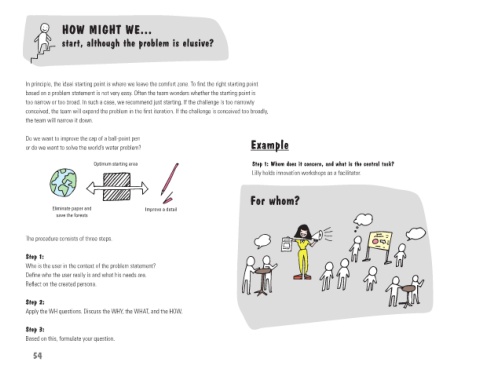
        Do we want to improve the cap of a ball-point pen
        or do we want to solve the world’s water problem?                Example

                            Optimum starting area                        Step 1: Whom does it concern, and what is the central task?
                                                                         Lilly holds innovation workshops as a facilitator.


                                                                        For whom?

                Eliminate paper and        Improve a detail
                 save the forests


        The procedure consists of three steps.

        Step 1:
        Who is the user in the context of the problem statement?
        Define who the user really is and what his needs are.
        Reflect on the created persona.

        Step 2:
        Apply the WH questions. Discuss the WHY, the WHAT, and the HOW.

        Step 3:
        Based on this, formulate your question.
          54

