


Page 59 - The Design Thinking Playbook
P. 59
1.4  How to discover user needs


        Priya has a new innovation project. Rumors have it that the Internet
        and technology giant where Priya is working will embrace the theme
        of health for seniors—a theme and a segment about which Priya
        knows little and which, for her personally, is still pretty remote.
        Actually, Priya has little time for taking the needs of seniors into           Define
        consideration alongside her numerous other projects. Her work envi-  Understand  Observe  point of   Ideate  Prototype  Test
        ronment teems with people in their mid-twenties; hardly anyone has              view
        yet crossed the threshold of 50 and can be classed even remotely in
        this segment. Her friends and acquaintances in Zurich are all between
        30 and 40 years old, and her parents are still working full time and   Users
        don’t feel they belong in the user group of retirees. Her grandparents,
        whom Priya could ask, have unfortunately passed away.

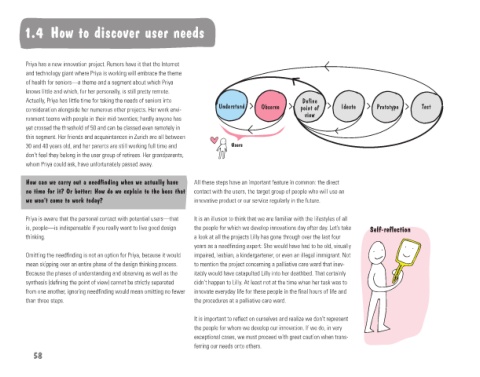
        How can we carry out a needfinding when we actually have   All these steps have an important feature in common: the direct
        no time for it? Or better: How do we explain to the boss that   contact with the users, the target group of people who will use an
        we won’t come to work today?                    innovative product or our service regularly in the future.

        Priya is aware that the personal contact with potential users—that   It is an illusion to think that we are familiar with the lifestyles of all
        is, people—is indispensable if you really want to live good design   the people for which we develop innovations day after day. Let’s take   Self-reflection
        thinking.                                       a look at all the projects Lilly has gone through over the last four
                                                        years as a needfinding expert: She would have had to be old, visually
        Omitting the needfinding is not an option for Priya, because it would   impaired, lesbian, a kindergartener, or even an illegal immigrant. Not
        mean skipping over an entire phase of the design thinking process.    to mention the project concerning a palliative care ward that inev-
        Because the phases of understanding and observing as well as the   itably would have catapulted Lilly into her deathbed. That certainly
        synthesis (defining the point of view) cannot be strictly separated   didn’t happen to Lilly. At least not at the time when her task was to
        from one another, ignoring needfinding would mean omitting no fewer   innovate everyday life for these people in the final hours of life and
        than three steps.                               the procedures at a palliative care ward.

                                                        It is important to reflect on ourselves and realize we don’t represent
                                                        the people for whom we develop our innovation. If we do, in very
                                                        exceptional cases, we must proceed with great caution when trans-
                                                        ferring our needs onto others.
           58

