


Page 76 - The Design Thinking Playbook
P. 76
EXPERT TIP

                   Mindfulness as the basis
                   of empathy and innovation success


             Mindfulness is a basic capability of our brain, but our ambition to   Why is it so hard for us to be empathetic?
             multitask makes us suppress this condition too often in our everyday
             lives. If we focus our attention purposefully, we are able to be more   It seems that society as a whole is getting increasingly incapable of empathy. This is probably because
             precise with our perception and be more present. Mindfulness may   in our achievement-oriented society, we are exposed to a constant pressure to optimize ourselves. If our
             be directed both inward and outward. Empathy is best built up when   interlocutor seems strange and foreign to us, or if we have already sorted him into a certain category of
             we focus on the current moment, involve all our senses, and perceive   people by our interpretations and conclusions, we will have a hard time empathizing with him. Other influ-
             the situation in an unprejudiced way. Mindfulness is the basis for   encing factors also affect our empathetic behavior: a stressful everyday life; pressure to succeed; hectic
             enhanced cognitive skills and is a vital aspect of the design thinking   situations; being wiped out; and emotional states such as anger, rage, and fear.
             mindset because it stimulates and promotes our creativity while   Behind these emotions, you usually find unfilled needs, unconscious beliefs, prejudices, and evaluation pat-
             cultivating our empathy and emotional intelligence. The things we   terns. All this reduces our willingness to put ourselves in others’ shoes and ultimately blocks our empathy.
             experience with great enthusiasm and attention, we internalize better.


                                                             Mindfulness as the key to empathy:
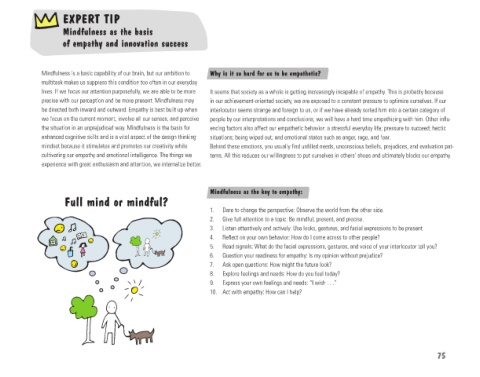
                   Full mind or mindful?
                                                             1.   Dare to change the perspective: Observe the world from the other side.
                                                             2.   Give full attention to a topic: Be mindful, present, and precise.
                                                             3.   Listen attentively and actively: Use looks, gestures, and facial expressions to be present.
                                                             4.   Reflect on your own behavior: How do I come across to other people?
                                                             5.   Read signals: What do the facial expressions, gestures, and voice of your interlocutor tell you?
                                                             6.   Question your readiness for empathy: Is my opinion without prejudice?
                                                             7.   Ask open questions: How might the future look?
                                                             8.   Explore feelings and needs: How do you feel today?
                                                             9.   Express your own feelings and needs: “I wish . . .”
                                                             10.  Act with empathy: How can I help?


                                                                                                                              75

