


Page 78 - The Design Thinking Playbook
P. 78
EXPERT TIP

                       Empathy in UX design and
                       the digital environment


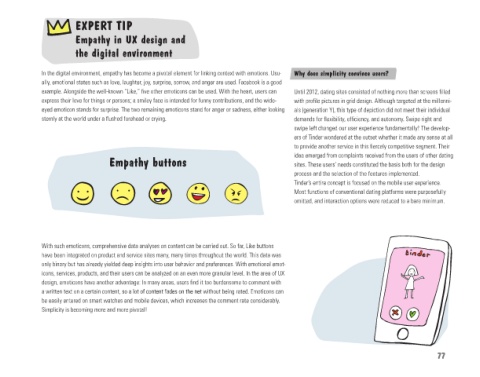
             In the digital environment, empathy has become a pivotal element for linking context with emotions. Usu-  Why does simplicity convince users?
             ally, emotional states such as love, laughter, joy, surprise, sorrow, and anger are used. Facebook is a good
             example. Alongside the well-known “Like,” five other emoticons can be used. With the heart, users can   Until 2012, dating sites consisted of nothing more than screens filled
             express their love for things or persons; a smiley face is intended for funny contributions, and the wide-  with profile pictures in grid design. Although targeted at the millenni-
             eyed emoticon stands for surprise. The two remaining emoticons stand for anger or sadness, either looking   als (generation Y), this type of depiction did not meet their individual
             sternly at the world under a flushed forehead or crying.                demands for flexibility, efficiency, and autonomy. Swipe right and
                                                                                     swipe left changed our user experience fundamentally! The develop-
                                                                                     ers of Tinder wondered at the outset whether it made any sense at all
                                                                                     to provide another service in this fiercely competitive segment. Their
                                                                                     idea emerged from complaints received from the users of other dating
                                Empathy buttons                                      sites. These users’ needs constituted the basis both for the design
                                                                                     process and the selection of the features implemented.
                                                                                     Tinder’s entire concept is focused on the mobile user experience.
                                                                                     Most functions of conventional dating platforms were purposefully
                                                                                     omitted, and interaction options were reduced to a bare minimum.


             With such emoticons, comprehensive data analyses on content can be carried out. So far, Like buttons
             have been integrated on product and service sites many, many times throughout the world. This data was
             only binary but has already yielded deep insights into user behavior and preferences. With emotional emot-
             icons, services, products, and their users can be analyzed on an even more granular level. In the area of UX
             design, emoticons have another advantage: In many areas, users find it too burdensome to comment with
             a written text on a certain content, so a lot of content fades on the net without being rated. Emoticons can
             be easily entered on smart watches and mobile devices, which increases the comment rate considerably.
             Simplicity is becoming more and more pivotal!


                                                                                                                              77

