


Page 9 - 60x80_Fall2016_FOR_FLIPBOOK_Neat
P. 9
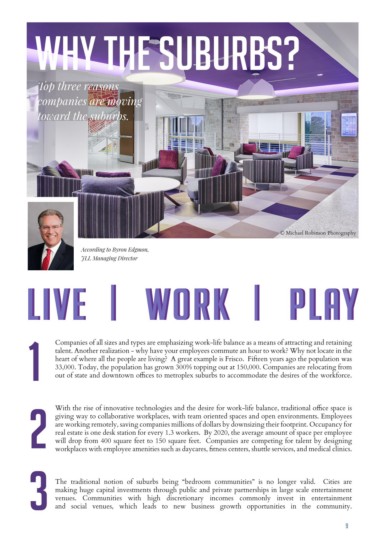
WHY THE SUBURBS?

Top three reasons
companies are moving
toward the suburbs.

                               © Michael Robinson Photography

   According to Byron Edgmon,
   JLL Managing Director

LIVE | WORK | PLAY

1 Companies of all sizes and types are emphasizing work-life balance as a means of attracting and retaining
            talent. Another realization - why have your employees commute an hour to work? Why not locate in the
            heart of where all the people are living? A great example is Frisco. Fifteen years ago the population was
            33,000. Today, the population has grown 300% topping out at 150,000. Companies are relocating from
            out of state and downtown offices to metroplex suburbs to accommodate the desires of the workforce.

2  With the rise of innovative technologies and the desire for work-life balance, traditional office space is
   giving way to collaborative workplaces, with team oriented spaces and open environments. Employees
   are working remotely, saving companies millions of dollars by downsizing their footprint. Occupancy for
   real estate is one desk station for every 1.3 workers. By 2020, the average amount of space per employee
   will drop from 400 square feet to 150 square feet. Companies are competing for talent by designing
   workplaces with employee amenities such as daycares, fitness centers, shuttle services, and medical clinics.

3  The traditional notion of suburbs being “bedroom communities” is no longer valid. Cities are
   making huge capital investments through public and private partnerships in large scale entertainment
   venues. Communities with high discretionary incomes commonly invest in entertainment
   and social venues, which leads to new business growth opportunities in the community.

                               9

