


Page 29 - mutual-fund-insight - Mar 2021_Neat
P. 29
0U [OL      ]LYZPVU VM [OL YPZR V TL[LY  :,)0 OHK MP_LK [OL YPZR SHILSZ MVY LHJO

          M\UK JH[LNVY` HUK LHJO M\UK ^HZ ZPTWS` HZZPNULK [OL ZHTL YPZR SHILS HZ [OH[ VM [OL JH[LNVY`
          )\[ PU YLHSP[`  M\UKZ VM [OL ZHTL JH[LNVY` KPMMLYLK ^PKLS` VU YPZRZ


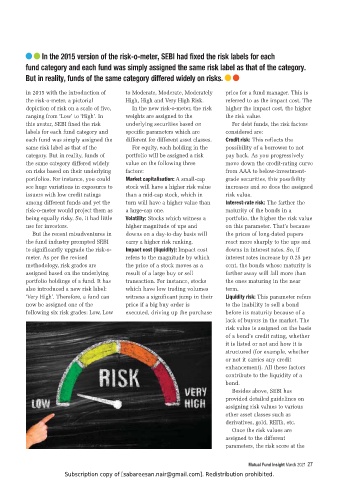
          in 2015 with the introduction of   to Moderate, Moderate, Moderately   price for a fund manager. This is
          the risk-o-meter, a pictorial      High, High and Very High Risk.     referred to as the impact cost. The
          depiction of risk on a scale of five,   In the new risk-o-meter, the risk   higher the impact cost, the higher
          ranging from ‘Low’ to ‘High’. In   weights are assigned to the        the risk value.
          this avatar, SEBI fixed the risk   underlying securities based on        For debt funds, the risk factors
          labels for each fund category and   specific parameters which are     considered are:
          each fund was simply assigned the   different for different asset classes.  Credit risk: This reflects the
          same risk label as that of the       For equity, each holding in the   possibility of a borrower to not
          category. But in reality, funds of   portfolio will be assigned a risk   pay back. As you progressively
          the same category differed widely   value on the following three      move down the credit-rating curve
          on risks based on their underlying   factors:                         from AAA to below-investment-
          portfolios. For instance, you could   Market capitalisation: A small-cap   grade securities, this possibility
          see huge variations in exposures to   stock will have a higher risk value   increases and so does the assigned
          issuers with low credit ratings    than a mid-cap stock, which in     risk value.
          among different funds and yet the   turn will have a higher value than   Interest-rate risk: The farther the
          risk-o-meter would project them as   a large-cap one.                 maturity of the bonds in a
          being equally risky. So, it had little   Volatility: Stocks which witness a   portfolio, the higher the risk value
          use for investors.                 higher magnitude of ups and        on this parameter. That’s because
            But the recent misadventures in   downs on a day-to-day basis will   the prices of long-dated papers
          the fund industry prompted SEBI    carry a higher risk ranking.       react more sharply to the ups and
          to significantly upgrade the risk-o-  Impact cost (liquidity): Impact cost   downs in interest rates. So, if
          meter. As per the revised          refers to the magnitude by which   interest rates increase by 0.25 per
          methodology, risk grades are       the price of a stock moves as a    cent, the bonds whose maturity is
          assigned based on the underlying   result of a large buy or sell      farther away will fall more than
          portfolio holdings of a fund. It has   transaction. For instance, stocks   the ones maturing in the near
          also introduced a new risk label:   which have low trading volumes    term.
          ‘Very High’. Therefore, a fund can   witness a significant jump in their   Liquidity risk: This parameter refers
          now be assigned one of the         price if a big buy order is        to the inability to sell a bond
          following six risk grades: Low, Low   executed, driving up the purchase   before its maturity because of a
                                                                                lack of buyers in the market. The
                                                                                risk value is assigned on the basis
                                                                                of a bond’s credit rating, whether
                                                                                it is listed or not and how it is
                                                                                structured (for example, whether
                                                                                or not it carries any credit
                                                                                enhancement). All these factors
                                                                                contribute to the liquidity of a
                                                                                bond.
                                                                                   Besides above, SEBI has
                                                                                provided detailed guidelines on
                                                                                assigning risk values to various
                                                                                other asset classes such as
                                                                                derivatives, gold, REITs, etc.
                                                                                   Once the risk values are
                                                                                assigned to the different
                                                                                parameters, the risk score at the


                                                                                        Mutual Fund Insight March 2021 27
                        Subscription copy of [sabareesan.nair@gmail.com]. Redistribution prohibited.

