


Page 18 - English Lesson Plan Year 3
P. 18
Primary Year 3 SK Scheme of Work
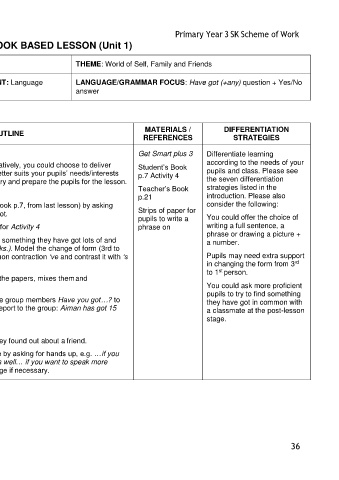
 SCHEME OF WORK: TEXTBOOK BASED LESSON (Unit 1)
    LESSON: 7 (Speaking 2)   MAIN SKILL FOCUS: Speaking   THEME: World of Self, Family and Friends
 WEEK: 2   TOPIC: Welcome!   CROSS-CURRICULAR ELEMENT: Language   LANGUAGE/GRAMMAR FOCUS: Have got (+any) question + Yes/No


                    answer


 CONTENT   LEARNING   LEARNING OUTLINE   MATERIALS /     DIFFERENTIATION
 STANDARD   STANDARD                 REFERENCES            STRATEGIES
       Pre-lesson                  Get Smart plus 3
 Main Skill   Main Skill                            Differentiate learning
 Speaking   Speaking   1. Play a game to review key vocabulary. Alternatively, you could choose to deliver   Student’s Book   according to the needs of your
 2.1   2.1.5   another appropriate pre-lesson activity that better suits your pupils’ needs/interests   p.7 Activity 4   pupils and class. Please see
 Communicate   Describe people   and that will review language and/or vocabulary and prepare the pupils for the lesson.   the seven differentiation
 simple information  and objects using   Lesson delivery   Teacher’s Book   strategies listed in the
                                                    introduction. Please also
 intelligibly   suitable words and   p.21
    phrases   2. Review the answers to Activity 3 (Student’s Book p.7, from last lesson) by asking   Strips of paper for   consider the following:
    pupils about the people and what they have got.   pupils to write a   You could offer the choice of
 Complementary   3. Follow the guidelines in Teacher’s Book p.21 for Activity 4   phrase on   writing a full sentence, a
 Skill   Complementary                              phrase or drawing a picture +
 Listening   Skill   4. Give pupils a strip of paper. Ask them to write something they have got lots of and   a number.
 1.2   Listening   how many they’ve got (e.g. I have got 15 books.). Model the change of form (3rd to
 Understand   1.2.5   1st person) as necessary. Point out the common contraction ‘ve and contrast it with ‘s   Pupils may need extra support
 meaning in a   Understand a wide   for third person.   in changing the form from 3 rd
                                                       st
 variety of familiar   range of short   5. Put pupils in large groups. One pupil collects the papers, mixes them and   to 1 person.
 contexts   supported questions
 redistributes them.                                You could ask more proficient
                                                    pupils to try to find something
 6. Pupils read the strips and take turns to ask the group members Have you got…? to   they have got in common with
 find out whose paper it is. At the end, pupils report to the group: Aiman has got 15   a classmate at the post-lesson
 books.                                             stage.
 Post-lesson
 7. Ask pupils to tell you something interesting they found out about a friend.
 8. Ask pupils to reflect on their own performance by asking for hands up, e.g. …if you
 spoke clearly …if you understood your friends well… if you want to speak more
 loudly… You could do this in their first language if necessary.


                                                                         36

