


Page 268 - English Lesson Plan Year 3
P. 268
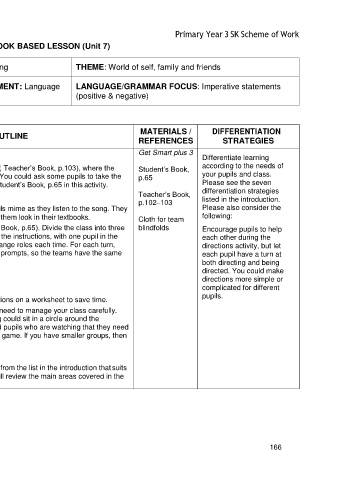
Primary Year 3 SK Scheme of Work
 SCHEME OF WORK: TEXTBOOK BASED LESSON (Unit 7)

 LESSON: 98 (Speaking 19)   MAIN SKILL FOCUS: Speaking   THEME: World of self, family and friends
 WEEK:   TOPIC: Out and about   CROSS-CURRICULAR ELEMENT: Language   LANGUAGE/GRAMMAR FOCUS: Imperative statements

                    (positive & negative)


 CONTENT   LEARNING                 MATERIALS /       DIFFERENTIATION
 STANDARD   STANDARD   LEARNING OUTLINE   REFERENCES    STRATEGIES
                                   Get Smart plus 3
 Main Skill   Main Skill   Pre-lesson              Differentiate learning
 Speaking 2.1   Speaking 2.1.3   1.  Play a version of Simon says (see Optional, Teacher’s Book, p.103), where the   Student’s Book,   according to the needs of
 Communicate   Give a short   pupils do the action only if you say please. You could ask some pupils to take the   p.65   your pupils and class.
 simple information   sequence of basic   role the teacher. Review vocabulary from Student’s Book, p.65 in this activity.      Please see the seven
 intelligibly   directions   Lesson delivery   Teacher’s Book,   differentiation strategies
                                   p.102–103       listed in the introduction.
                                                   Please also consider the
       2.  Play the song from Activity 1 and have pupils mime as they listen to the song. They
 might want to sing as well but avoid having them look in their textbooks.   Cloth for team   following:
 Complementary   Complementary   3.  Follow instructions for Activity 2 (Teacher’s Book, p.65). Divide the class into three   blindfolds   Encourage pupils to help
 Skill   Skill   or four teams. Pupils take it in turns to race the instructions, with one pupil in the   each other during the
 Listening 1.2   Listening 1.2.4   maze and one pupil giving directions. Exchange roles each time. For each turn,   directions activity, but let
 Understand   Understand a wide   write the basic instructions on the board as prompts, so the teams have the same   each pupil have a turn at
 meaning in a   range of short basic   number of steps. For example:   both directing and being
 variety of familiar   supported   Team 1: right / straight / left / stop   directed. You could make
 contexts   classroom                              directions more simple or
 instructions   Team 2: straight / right / straight / stop   complicated for different

 Alternatively, you could prepare the instructions on a worksheet to save time.   pupils.
 This game will be quite noisy and you may need to manage your class carefully.
 For example, the pupils who are not playing could sit in a circle around the
 classroom so you can see them all. Remind pupils who are watching that they need
 to be quiet so their teammates can play the game. If you have smaller groups, then
 there will be fewer pupils watching.
 Post-lesson
 4.  Choose an appropriate post-lesson activity from the list in the introduction that suits
 your pupils’ needs and interests and that will review the main areas covered in the
 lesson.


                                                                    166

