


Page 263 - English Lesson Plan Year 3
P. 263
Primary Year 3 SK Scheme of Work
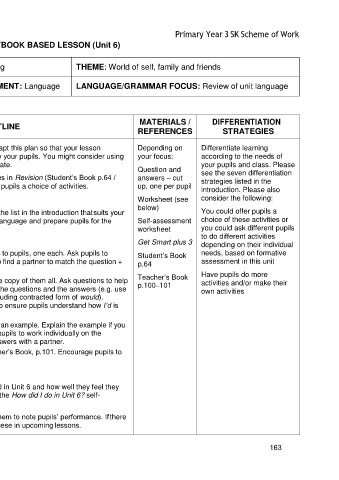
 SCHEME OF WORK: NON-TEXTBOOK BASED LESSON (Unit 6)

 WEEK:   LESSON: 96 (Language Awareness 5)   MAIN SKILL FOCUS: Reading   THEME: World of self, family and friends

                    LANGUAGE/GRAMMAR FOCUS: Review of unit language
 CROSS-CURRICULAR ELEMENT: Language
 TOPIC: Food, please!


 CONTENT   LEARNING                 MATERIALS /       DIFFERENTIATION
 STANDARD   STANDARD   LEARNING OUTLINE   REFERENCES    STRATEGIES

 Main Skill   Main Skill   Use your notes made on pupils during this unit to adapt this plan so that your lesson   Depending on   Differentiate learning
 Reading 3.2   Reading 3.2.2   consolidates and extends language areas needed by your pupils. You might consider using   your focus:   according to the needs of
 Understand a   Understand   some of the material as a homework task, if appropriate.   Question and   your pupils and class. Please
 variety of linear   specific   Note: You could also make use of the review activities in Revision (Student’s Book p.64 /   answers – cut   see the seven differentiation
 and non-linear   information and   Teacher’s Book p.100–101) and/or consider offering pupils a choice of activities.   up, one per pupil   strategies listed in the
 print and digital   details of short              introduction. Please also
 texts by using   simple texts   Pre-lesson   Worksheet (see   consider the following:
 appropriate      1.  Choose an appropriate pre-lesson activity from the list in the introduction that suits your   below)   You could offer pupils a
 reading      pupils’ needs and interests and that will review language and prepare pupils for the   Self-assessment   choice of these activities or
 strategies   lesson.              worksheet       you could ask different pupils
    Complementary                                  to do different activities
    Skill   Lesson delivery        Get Smart plus 3   depending on their individual
 Complementary  Speaking 2.1.1   2.  Mix up and hand out question and answer strips to pupils, one each. Ask pupils to   needs, based on formative
 Skill   Ask about and   mingle (walk around talking to different pupils) to find a partner to match the question +   Student’s Book   assessment in this unit
 Speaking 2.1   express basic   answer.   p.64
 Communicate   opinions   3.  Write the questions on the board or show a large copy of them all. Ask questions to help   Teacher’s Book   Have pupils do more
 simple   pupils see the relationship between the form of the questions and the answers (e.g. use   p.100–101   activities and/or make their
 information   of do/there + be / the repetition of the verbs, including contracted form of would).   own activities
 intelligibly
 Carefully explain the contraction form of would to ensure pupils understand how I’d is
 constructed.
 4.  Model the worksheet activity on the board using an example. Explain the example if you
 think it is necessary in addition to Stage 3. Ask pupils to work individually on the
 worksheet (see below) before checking their answers with a partner.
 5.  Follow instructions for Optional activity on Teacher’s Book, p.101. Encourage pupils to
 give reasons.
 Post-lesson
 6.  Ask pupils to think about what they have learned in Unit 6 and how well they feel they
 know the language now. They should complete the How did I do in Unit 6? self-
 assessment section of the worksheet.
 7.  Collect the worksheets from pupils and review them to note pupils’ performance. If there
 are any areas of concern, prepare a review of these in upcoming lessons.


                                                                    163

