


Page 230 - How to Make Money in Stocks Trilogy
P. 230
How to Read Charts Like a Pro and Improve Your Selection and Timing 113


                                                          High of handlegg
                                                          pivot


                    %
                    Depth


                                      Base length

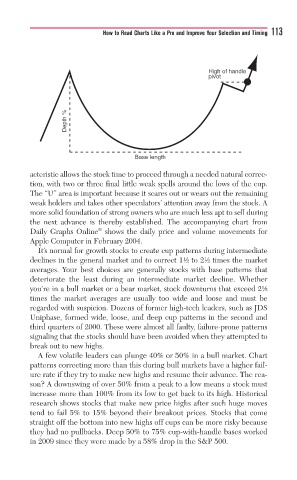
          acteristic allows the stock time to proceed through a needed natural correc-
          tion, with two or three final little weak spells around the lows of the cup.
          The “U” area is important because it scares out or wears out the remaining
          weak holders and takes other speculators’ attention away from the stock. A
          more solid foundation of strong owners who are much less apt to sell during
          the next advance is thereby established. The accompanying chart from
                            ®
          Daily Graphs Online shows the daily price and volume movements for
          Apple Computer in February 2004.
            It’s normal for growth stocks to create cup patterns during intermediate
          declines in the general market and to correct 1½ to 2½ times the market
          averages. Your best choices are generally stocks with base patterns that
          deteriorate the least during an intermediate market decline. Whether
          you’re in a bull market or a bear market, stock downturns that exceed 2½
          times the market averages are usually too wide and loose and must be
          regarded with suspicion. Dozens of former high-tech leaders, such as JDS
          Uniphase, formed wide, loose, and deep cup patterns in the second and
          third quarters of 2000. These were almost all faulty, failure-prone patterns
          signaling that the stocks should have been avoided when they attempted to
          break out to new highs.
            A few volatile leaders can plunge 40% or 50% in a bull market. Chart
          patterns correcting more than this during bull markets have a higher fail-
          ure rate if they try to make new highs and resume their advance. The rea-
          son? A downswing of over 50% from a peak to a low means a stock must
          increase more than 100% from its low to get back to its high. Historical
          research shows stocks that make new price highs after such huge moves
          tend to fail 5% to 15% beyond their breakout prices. Stocks that come
          straight off the bottom into new highs off cups can be more risky because
          they had no pullbacks. Deep 50% to 75% cup-with-handle bases worked
          in 2009 since they were made by a 58% drop in the S&P 500.

