


Page 262 - How to Make Money in Stocks Trilogy
P. 262
How to Read Charts Like a Pro and Improve Your Selection and Timing 143


                     Comverse Tech    Large point spreads fromgpoint  p e  s fro m  Price
                                      Large
                                                            190
                                      high to low each weekh
                                      hi high  low e  h e  k
                                             h
                     Weekly Chart     throughout            160
                                      throughout basebaseeout b
                                      throu
                                                            140
                                                            120
                      D Do NOTNOTNOT
                       Buyu
                       Buy                                  100
                                                            80
                                                            70
                                                            60
                        D D Down 50% i50%50%w  n i
                        12 weeksweekskw k                   50
                        12
                        1
                                                            40
                                                            34
                                                            30
                                                            26
                                                            22
                             2/1                            19
                                                            Volume © 2009 Investor’s Business Daily, Inc.
                                                          16,000,000
                                                           8,000,000
                                                           4,000,000
                                                           2,000,000
                        Mar 2000  Jun 2000  Sep 2000  Dec 2000  Mar 2001  Jun 2001  Sep 2001
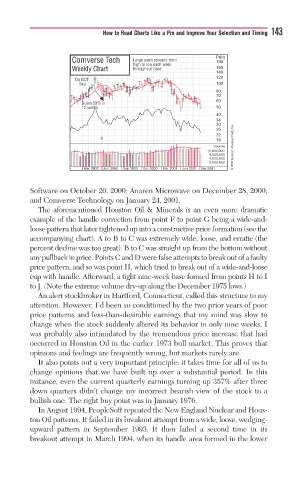
          Software on October 20, 2000; Anaren Microwave on December 28, 2000;
          and Comverse Technology on January 24, 2001.
            The aforementioned Houston Oil & Minerals is an even more dramatic
          example of the handle correction from point F to point G being a wide-and-
          loose pattern that later tightened up into a constructive price formation (see the
          accompanying chart). A to B to C was extremely wide, loose, and erratic (the
          percent decline was too great). B to C was straight up from the bottom without
          any pullback in price. Points C and D were false attempts to break out of a faulty
          price pattern, and so was point H, which tried to break out of a wide-and-loose
          cup with handle. Afterward, a tight nine-week base formed from points H to I
          to J. (Note the extreme volume dry-up along the December 1975 lows.)
            An alert stockbroker in Hartford, Connecticut, called this structure to my
          attention. However, I’d been so conditioned by the two prior years of poor
          price patterns and less-than-desirable earnings that my mind was slow to
          change when the stock suddenly altered its behavior in only nine weeks. I
          was probably also intimidated by the tremendous price increase that had
          occurred in Houston Oil in the earlier 1973 bull market. This proves that
          opinions and feelings are frequently wrong, but markets rarely are.
            It also points out a very important principle: it takes time for all of us to
          change opinions that we have built up over a substantial period. In this
          instance, even the current quarterly earnings turning up 357% after three
          down quarters didn’t change my incorrect bearish view of the stock to a
          bullish one. The right buy point was in January 1976.
            In August 1994, PeopleSoft repeated the New England Nuclear and Hous-
          ton Oil patterns. It failed in its breakout attempt from a wide, loose, wedging-
          upward pattern in September 1993. It then failed a second time in its
          breakout attempt in March 1994, when its handle area formed in the lower

