


Page 258 - How to Make Money in Stocks Trilogy
P. 258
140  A WINNING SYSTEM


                                                            Price
                     Titanium Metals                        46
                     Weekly Chart              Buy pointin nttt  36
                                               B B
                                                yppp
                                                            27
                                                            23
                                                            19
                                                   C C      16
                                              A A A A  B B  13
                                                            11
                                                            9
                                             Ascending baseedingc
                                             3 3 higher lows andhigher lows andaer loi  7
                                             3 3 higher highshigher highser hii g  g  6
                                                            4.6
                                             V Volume uppolume uppeu  3.6
                                        2/1      2/1   2/1
                                                           Volume © 2009 Investor’s Business Daily, Inc.
                                                          25,000,000
                                                          12,000,000
                                                          6,000,000
                                                          3,000,000
                     Dec 2004  Mar 2005  Jun 2005  Sep 2005  Dec 2005  Mar 2006  Jun 2006
          Wide-and-Loose Price Structures Are Failure Prone
          Wide-and-loose-looking charts usually fail but can tighten up later. New
          England Nuclear and Houston Oil & Minerals are two cases of stocks that
          tightened up following wide, loose, and erratic price movements. I cite
          them because I missed both of them at the time. It’s always wise to review
          big winners that you missed to find out why you didn’t recognize them when
          they were exactly right and ready to soar.
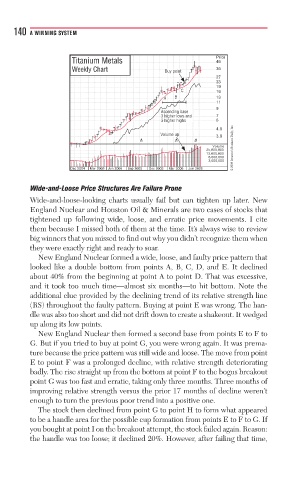
            New England Nuclear formed a wide, loose, and faulty price pattern that
          looked like a double bottom from points A, B, C, D, and E. It declined
          about 40% from the beginning at point A to point D. That was excessive,
          and it took too much time—almost six months—to hit bottom. Note the
          additional clue provided by the declining trend of its relative strength line
          (RS) throughout the faulty pattern. Buying at point E was wrong. The han-
          dle was also too short and did not drift down to create a shakeout. It wedged
          up along its low points.
            New England Nuclear then formed a second base from points E to F to
          G. But if you tried to buy at point G, you were wrong again. It was prema-
          ture because the price pattern was still wide and loose. The move from point
          E to point F was a prolonged decline, with relative strength deteriorating
          badly. The rise straight up from the bottom at point F to the bogus breakout
          point G was too fast and erratic, taking only three months. Three months of
          improving relative strength versus the prior 17 months of decline weren’t
          enough to turn the previous poor trend into a positive one.
            The stock then declined from point G to point H to form what appeared
          to be a handle area for the possible cup formation from points E to F to G. If
          you bought at point I on the breakout attempt, the stock failed again. Reason:
          the handle was too loose; it declined 20%. However, after failing that time,

