


Page 341 - How to Make Money in Stocks Trilogy
P. 341
M = Market Direction: How You Can Determine It 217


           1929 Dow Jones Industrials  Market Top                      Index
                                                                       Scale
                                        Stall
                                 1  2 3  Stall y  4
                                        day
                                        d
                                        day
                                             5                          400
                                                                        350
                                                                        300
                       W               y          g  k et tops,
                       When
                                                      et tops,o
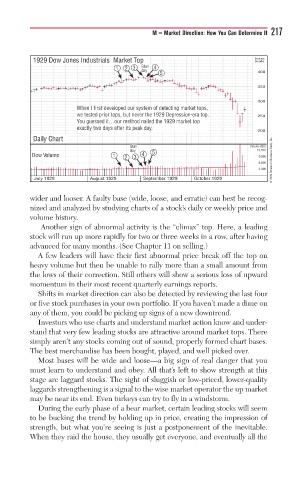
                       When I first developed our system of detecting markpI first developed our system of detecting markaetectinmslt
                       we
                       we tested prior tops, but never the 1929 Depression-tested prior tops, but never the 1929 Depressione tested p io tops b t ne e the 1929 Dep esssiono9 Depe 1929vuors
                       w                             -era top.era top.e a topa  . .  250
                                                     -
                       Y Y Y You guessed it…our method nailed the 1929 market ou guessed itou guessed itdu  our  kk  topp
                                                      top
                                 our method nmethod nailed the 1929 market19299ed the dm
                       Y Y Y Y Y
                       exactly two days ay two ddays ay  y  f fter its peak dapter its peak daai  y y y y.
                       e
                       exactly
                                                                        200
           Daily Chart
                                     Stall                            Volume (00)
                                     day
                                     day y                              13,200
          Dow Volume            1   2  3  4  5                          9,900
                                                                        6,600 © 2009 Investor’s Business Daily, Inc.
                                                                        3,300
           July 1929      August 1929    September 1929  October 1929
          wider and looser. A faulty base (wide, loose, and erratic) can best be recog-
          nized and analyzed by studying charts of a stock’s daily or weekly price and
          volume history.
             Another sign of abnormal activity is the “climax” top. Here, a leading
          stock will run up more rapidly for two or three weeks in a row, after having
          advanced for many months. (See Chapter 11 on selling.)
            A few leaders will have their first abnormal price break off the top on
          heavy volume but then be unable to rally more than a small amount from
          the lows of their correction. Still others will show a serious loss of upward
          momentum in their most recent quarterly earnings reports.
            Shifts in market direction can also be detected by reviewing the last four
          or five stock purchases in your own portfolio. If you haven’t made a dime on
          any of them, you could be picking up signs of a new downtrend.
            Investors who use charts and understand market action know and under-
          stand that very few leading stocks are attractive around market tops. There
          simply aren’t any stocks coming out of sound, properly formed chart bases.
          The best merchandise has been bought, played, and well picked over.
            Most bases will be wide and loose—a big sign of real danger that you
          must learn to understand and obey. All that’s left to show strength at this
          stage are laggard stocks. The sight of sluggish or low-priced, lower-quality
          laggards strengthening is a signal to the wise market operator the up market
          may be near its end. Even turkeys can try to fly in a windstorm.
            During the early phase of a bear market, certain leading stocks will seem
          to be bucking the trend by holding up in price, creating the impression of
          strength, but what you’re seeing is just a postponement of the inevitable.
          When they raid the house, they usually get everyone, and eventually all the

