


Page 538 - How to Make Money in Stocks Trilogy
P. 538
Institutional Portfolio Ideas 407


                                                                     Price
            Express Scripts                                           220
            Weekly Chart                                              190
                                                                S&P 500  160
                                                                      140
            3 3-year annual eps growth                                120
            + +27%, +45%, +30%                                        100
                                             New Leader IdeaLeader Ideaader  80
                                             N
                                             New
             Last 3 quarters eps                                      70
            + +33%, +33%, +25%                                        60
                                                       6 6 weeks in shakeout areaweeks in shakeout areaakeokw  50
             ROE 88%                      1            under low price at point 1.ce atd  40
                                                       B
                                             Doubleo   Buy point occurs when stocki t occuoy  urs w h  t k
                                                       recovers
            E Earnings, pre-tax margins ,    bottommo  recovers 5 points above low at5 points above lowpoiec  3 rrule).ule)  t at  34
                                             b
                                                                      30
                                                       point
                                                       point 1 (Shakeout + 3 1 (Shakeoutthake1i
                                                       point 1 (Shakeout + 3
            a and return on equity up 8                V V Volume on that day was 139%olume on that day was 139%a thaml  26
            y years in a row                           above          22
                                                       above average daily volume.average daily volumeirageo
                                                       V Volume for week was up 57%.olume for week was up 57%wr weml  19
            8 8quartersof increased                                 Volume
            m mutual fund ownership                                15,000,000
                                                                   8,000,000
                                                                   4,000,000
             P/E Ratio 18                                          2,000,000
                                Jun 2008  Sep 2008  Dec 2008  Mar 2009  Jun 2009  Sep 2009  Dec 2009
                         Institutional Investors: An Overview
          In 1929, the public was heavily involved in stocks, speculating with 10%
          cash and 90% margin. This is one reason why so many people got hurt when
          the market collapsed . . . they had too much debt.
            However, margin debt as a percentage of market capitalization of NYSE
          stocks also reached an extreme level at the end of March 2000.
            Banks in 1929 also had huge mortgage debt. This time around, banks had
          lower-quality mortgage debt. However, this subprime debt was strongly man-
          dated and pursued by our key politicians in government from 1995 on, some-
          thing they don’t want to admit as they investigate and blame everyone else
          rather than take responsibility for their major role in creating the subprime
          loan 2008 financial crisis. Great government intention—catastrophic results.
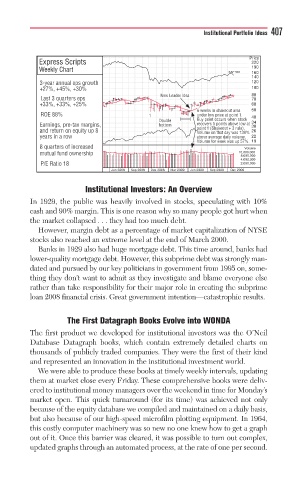
                    The First Datagraph Books Evolve into WONDA
          The first product we developed for institutional investors was the O’Neil
          Database Datagraph books, which contain extremely detailed charts on
          thousands of publicly traded companies. They were the first of their kind
          and represented an innovation in the institutional investment world.
            We were able to produce these books at timely weekly intervals, updating
          them at market close every Friday. These comprehensive books were deliv-
          ered to institutional money managers over the weekend in time for Monday’s
          market open. This quick turnaround (for its time) was achieved not only
          because of the equity database we compiled and maintained on a daily basis,
          but also because of our high-speed microfilm plotting equipment. In 1964,
          this costly computer machinery was so new no one knew how to get a graph
          out of it. Once this barrier was cleared, it was possible to turn out complex,
          updated graphs through an automated process, at the rate of one per second.

