


Page 211 - Learn To Program With Scratch
P. 211
In the next section, we’ll explore some of the most common operations
on strings and see some strategies for writing string manipulation proce-
dures in Scratch.
String manipulation examples
The letter of operator only lets you read the individual characters of a
string. If you want to insert characters into (or remove characters from)
a string, you have to do all the work yourself.
In Scratch, you can’t alter the characters in a string, so the only way to
change a string is to create a new one. For example, if you want to capital-
ize the first letter in the string “jack”, you need to create a new string that
contains the letter J followed by the rest of the letters, ack. The idea is to use
the letter of operator to read the letters of the original string and append
theses letters to the new string, as needed, using the join operator.
In this section, we’ll develop some simple applications that demonstrate
common string manipulation techniques.
Igpay Atinlay
PigLatin .sb2 What if our sprites could speak a secret language? In this section, we’ll
teach them a coded language called pig latin. Our rules for creating pig
latin words will be simple. To convert a word into pig latin, move the first
letter to the end and add the letters ay. So, the word talk becomes alktay, fun
becomes unfay, and so on. Now that you know the rules, can you tell what
the title of this section originally said?
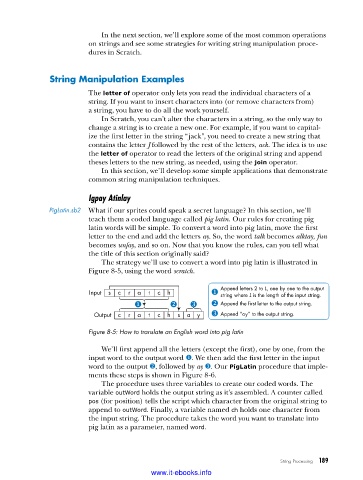
The strategy we’ll use to convert a word into pig latin is illustrated in
Figure 8-5, using the word scratch.
Input s c r a t c h Append letters 2 to L, one by one to the output
string where L is the length of the input string.
Append the first letter to the output string.
Output c r a t c h s a y Append “ay” to the output string.
Figure 8-5: How to translate an English word into pig latin
We’ll first append all the letters (except the first), one by one, from the
input word to the output word u. We then add the first letter in the input
word to the output v, followed by ay w. Our PigLatin procedure that imple-
ments these steps is shown in Figure 8-6.
The procedure uses three variables to create our coded words. The
variable outWord holds the output string as it’s assembled. A counter called
pos (for position) tells the script which character from the original string to
append to outWord. Finally, a variable named ch holds one character from
the input string. The procedure takes the word you want to translate into
pig latin as a parameter, named word.
String Processing 189
www.it-ebooks.info

