


Page 212 - Learn To Program With Scratch
P. 212
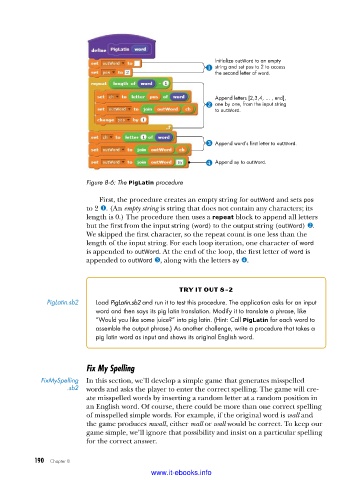
Initialize outWord to an empty
string and set pos to 2 to access
the second letter of word.
Append letters [2,3,4, ... , end],
one by one, from the input string
to outWord.
Append word’s first letter to outWord.
Append ay to outWord.
Figure 8-6: The PigLatin procedure
First, the procedure creates an empty string for outWord and sets pos
to 2 u. (An empty string is string that does not contain any characters; its
length is 0.) The procedure then uses a repeat block to append all letters
but the first from the input string (word) to the output string (outWord) v.
We skipped the first character, so the repeat count is one less than the
length of the input string. For each loop iteration, one character of word
is appended to outWord. At the end of the loop, the first letter of word is
appended to outWord w, along with the letters ay x.
try it out 8-2
PigLatin .sb2 Load PigLatin.sb2 and run it to test this procedure . The application asks for an input
word and then says its pig latin translation . Modify it to translate a phrase, like
“Would you like some juice?” into pig latin . (Hint: Call PigLatin for each word to
assemble the output phrase .) As another challenge, write a procedure that takes a
pig latin word as input and shows its original English word .
Fix My Spelling
FixMySpelling In this section, we’ll develop a simple game that generates misspelled
.sb2 words and asks the player to enter the correct spelling. The game will cre-
ate misspelled words by inserting a random letter at a random position in
an English word. Of course, there could be more than one correct spelling
of misspelled simple words. For example, if the original word is wall and
the game produces mwall, either mall or wall would be correct. To keep our
game simple, we’ll ignore that possibility and insist on a particular spelling
for the correct answer.
190 Chapter 8
www.it-ebooks.info

