


Page 208 - Learn To Program With Scratch
P. 208
revisiting the String data type
As I mentioned in Chapter 5, Scratch has three data types: Boolean, number,
and string. At its simplest, a string is just an ordered sequence of characters.
These characters can include letters (both upper- and lowercase), digits,
and other symbols that you can type on your keyboard (+, -, &, @, and so
on). You can use strings in your programs to store names, addresses, phone
numbers, book titles, and more.
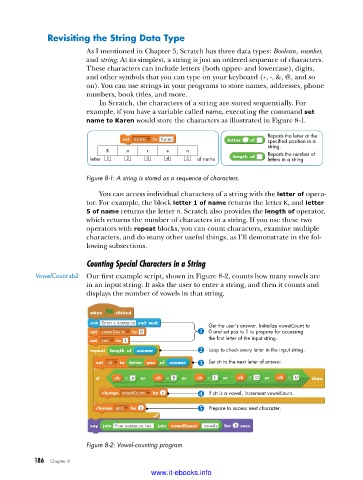
In Scratch, the characters of a string are stored sequentially. For
e xample, if you have a variable called name, executing the command set
name to Karen would store the characters as illustrated in Figure 8-1.
Reports the letter at the
specified position in a
string.
K a r e n Reports the number of
letter 1 2 3 4 5 of name letters in a string.
Figure 8-1: A string is stored as a sequence of characters .
You can access individual characters of a string with the letter of opera-
tor. For example, the block letter 1 of name returns the letter K, and letter
5 of name returns the letter n. Scratch also provides the length of operator,
which returns the number of characters in a string. If you use these two
operators with repeat blocks, you can count characters, examine multiple
characters, and do many other useful things, as I’ll demonstrate in the fol-
lowing subsections.
Counting Special Characters in a String
VowelCount .sb2 Our first example script, shown in Figure 8-2, counts how many vowels are
in an input string. It asks the user to enter a string, and then it counts and
displays the number of vowels in that string.
Get the user’s answer. Initialize vowelCount to
0 and set pos to 1 to prepare for accessing
the first letter of the input string.
Loop to check every letter in the input string.
Set ch to the next letter of answer.
If ch is a vowel, increment vowelCount.
Prepare to access next character.
Figure 8-2: Vowel-counting program
186 Chapter 8
www.it-ebooks.info

