


Page 163 - Programming With Python 3
P. 163
An Introduction to STEM Programming with Python — 2019-09-03a                              Page 150
            Chapter 13 — Persistent Data

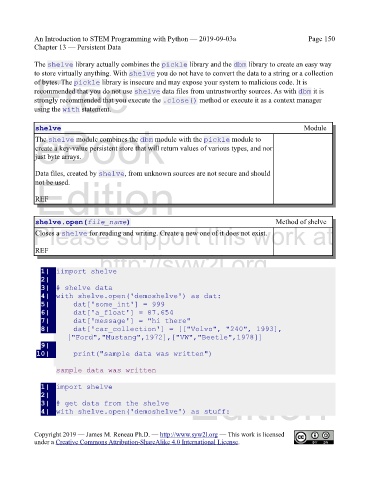
            The shelve library actually combines the pickle library and the dbm library to create an easy way
            to store virtually anything. With shelve you do not have to convert the data to a string or a collection
             Free
            of bytes. The pickle library is insecure and may expose your system to malicious code. It is
            recommended that you do not use shelve data files from untrustworthy sources. As with dbm it is
            strongly recommended that you execute the .close() method or execute it as a context manager
            using the with statement.

             eBook
             shelve                                                                                   Module
             The shelve module combines the dbm module with the pickle module to
             create a key-value persistent store that will return values of various types, and nor
             just byte arrays.

             Data files, created by shelve, from unknown sources are not secure and should
             Edition
             not be used.

             REF


             shelve.open(file_name)                                                         Method of shelve
            Please support this work at
             Closes a shelve for reading and writing. Create a new one of it does not exist.


             REF
                                  http://syw2l.org

               1|  iimport shelve
               2|
               3|  # shelve data
               4|  with shelve.open('demoshelve') as dat:                      Free
               5|      dat['some_int'] = 999
               6|      dat['a_float'] = 87.654
               7|      dat['message'] = "hi there"
               8|      dat['car_collection'] = [["Volvo", "240", 1993],
                                                                   eBook
                       ["Ford","Mustang",1972],["VW","Beetle",1978]]
               9|
             10|      print("sample data was written")


                    sample data was written

               1|  import shelve
               2|
               3|  # get data from the shelve                   Edition
               4|  with shelve.open('demoshelve') as stuff:


            Copyright 2019 — James M. Reneau Ph.D. — http://www.syw2l.org — This work is licensed
            under a Creative Commons Attribution-ShareAlike 4.0 International License.

