


Page 164 - Programming With Python 3
P. 164
An Introduction to STEM Programming with Python — 2019-09-03a                              Page 151
            Chapter 13 — Persistent Data

               5|      print("an integer ->", stuff['some_int'])
               6|      print("a float ->", stuff['a_float'])
             Free
               7|      print("a string ->", stuff['message'])
               8|      print("a list ->", stuff['car_collection'])

                    an integer -> 999
                    a float -> 87.654
                    a string -> hi there
             eBook
                    a list -> [['Volvo', '240', 1993], ['Ford', 'Mustang', 1972],
                    ['VW', 'Beetle', 1978]]


                NOTE: It is recommended that when accessing values from either a dbm or shelve database
                that you trap for errors; check to see if the key exists (using the in operator); or use the
                .get(key, default) method with a default value.
             Edition


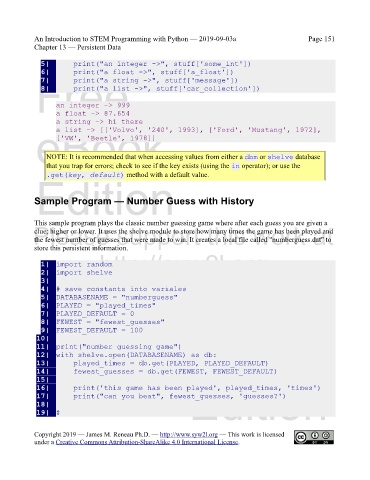
            Sample Program — Number Guess with History


            This sample program plays the classic number guessing game where after each guess you are given a
            Please support this work at
            clue; higher or lower. It uses the shelve module to store how many times the game has been played and
            the fewest number of guesses that were made to win. It creates a local file called "numberguess.dat" to
            store this persistent information.
                                  http://syw2l.org
               1|  import random
               2|  import shelve
               3|
               4|  # save constants into variales
               5|  DATABASENAME = "numberguess"                                Free
               6|  PLAYED = "played_times"
               7|  PLAYED_DEFAULT = 0
               8|  FEWEST = "fewest_guesses"
               9|  FEWEST_DEFAULT = 100
             10|
             11|  print("number guessing game")                    eBook
             12|  with shelve.open(DATABASENAME) as db:
             13|      played_times = db.get(PLAYED, PLAYED_DEFAULT)
             14|      fewest_guesses = db.get(FEWEST, FEWEST_DEFAULT)
             15|
                                                                Edition
             16|      print('this game has been played', played_times, 'times')
             17|      print("can you beat", fewest_guesses, 'guesses?')
             18|
             19|  #


            Copyright 2019 — James M. Reneau Ph.D. — http://www.syw2l.org — This work is licensed
            under a Creative Commons Attribution-ShareAlike 4.0 International License.

