


Page 3 - Unit2.docx
P. 3
The pile behaves as an ordinary column and should be designed as such. Even in
                      weak soil a pile will not fail by buckling and this effect need only be considered if
                      part of the pile is unsupported, i.e. if it is in either air or water. Load is transmitted
                      to the soil through friction or cohesion. But sometimes, the soil surrounding the
                      pile may adhere to the surface of the pile and causes "Negative Skin Friction" on
                      the pile. This, sometimes have considerable effect on the capacity of the pile.
                      Negative skin friction is caused by the drainage of the ground water and
                      consolidation of the soil. The founding depth of the pile is influenced by the results
                      of the site investigate on and soil test.


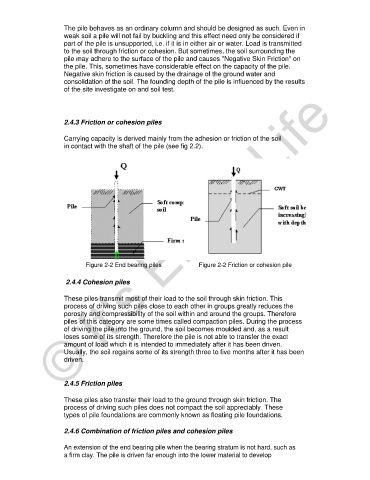
                      2.4.3 Friction or cohesion piles

                      Carrying capacity is derived mainly from the adhesion or friction of the soil
                      in contact with the shaft of the pile (see fig 2.2).


                      © It's Engg. Life


                             Figure 2-2 End bearing piles          Figure 2-2 Friction or cohesion pile

                       2.4.4 Cohesion piles

                      These piles transmit most of their load to the soil through skin friction. This
                      process of driving such piles close to each other in groups greatly reduces the
                      porosity and compressibility of the soil within and around the groups. Therefore
                      piles of this category are some times called compaction piles. During the process
                      of driving the pile into the ground, the soil becomes moulded and, as a result
                      loses some of its strength. Therefore the pile is not able to transfer the exact
                      amount of load which it is intended to immediately after it has been driven.
                      Usually, the soil regains some of its strength three to five months after it has been
                      driven.


                      2.4.5 Friction piles

                      These piles also transfer their load to the ground through skin friction. The
                      process of driving such piles does not compact the soil appreciably. These
                      types of pile foundations are commonly known as floating pile foundations.

                      2.4.6 Combination of friction piles and cohesion piles

                      An extension of the end bearing pile when the bearing stratum is not hard, such as
                      a firm clay. The pile is driven far enough into the lower material to develop

