


Page 6 - Unit2.docx
P. 6
2.4.20 Driven and cast in place Concrete piles

                      Two of the main types used in the UK are: West’s shell pile : Pre cast, reinforced
                      concrete tubes, about 2 m long, are threaded on to a steel mandrel and driven
                      into the ground after a concrete shoe has been placed at the front of the shells.
                      © It's Engg. Life
                      Once the shells have been driven to specified depth the mandrel is withdrawn and
                      reinforced concrete inserted in the core. Diameters vary from 325 to 600 mm.

                      Franki Pile: A steel tube is erected vertically over the place where the pile is to be
                      driven, and about a metre depth of gravel is placed at the end of the tube. A drop
                      hammer, 2500 to 4000kg mass, compacts the aggregate into a solid plug which
                      then penetrates the soil and takes the steel tube down with it. When the required
                      depth has been achieved the tube is raised slightly and the aggregate broken out.
                      Dry concrete is now added and hammered until a bulb is formed. Reinforcement
                      is placed in position and more dry concrete is placed and rammed until the pile
                      top comes up to ground level.


                      2.4.22 Steel piles

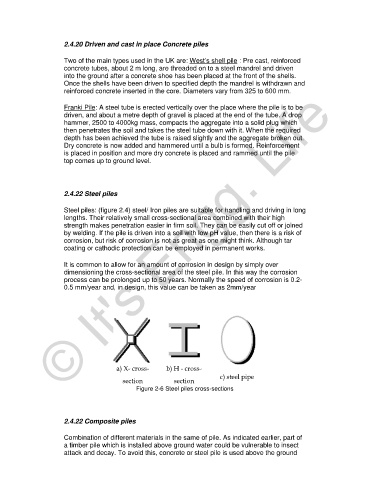
                      Steel piles: (figure 2.4) steel/ Iron piles are suitable for handling and driving in long
                      lengths. Their relatively small cross-sectional area combined with their high
                      strength makes penetration easier in firm soil. They can be easily cut off or joined
                      by welding. If the pile is driven into a soil with low pH value, then there is a risk of
                      corrosion, but risk of corrosion is not as great as one might think. Although tar
                      coating or cathodic protection can be employed in permanent works.

                      It is common to allow for an amount of corrosion in design by simply over
                      dimensioning the cross-sectional area of the steel pile. In this way the corrosion
                      process can be prolonged up to 50 years. Normally the speed of corrosion is 0.2-
                      0.5 mm/year and, in design, this value can be taken as 2mm/year


                                        a) X- cross-    b) H - cross-
                                                                          c) steel pipe
                                          section          section
                                              Figure 2-6 Steel piles cross-sections


                      2.4.22 Composite piles

                      Combination of different materials in the same of pile. As indicated earlier, part of
                      a timber pile which is installed above ground water could be vulnerable to insect
                      attack and decay. To avoid this, concrete or steel pile is used above the ground

