


Page 4 - Unit2.docx
P. 4
adequate frictional resistance. A farther variation of the end bearing pile is piles
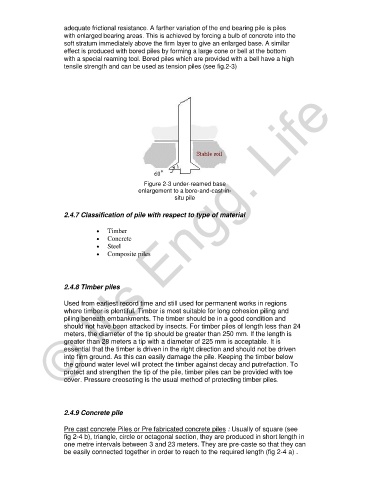
                      with enlarged bearing areas. This is achieved by forcing a bulb of concrete into the
                      soft stratum immediately above the firm layer to give an enlarged base. A similar
                      effect is produced with bored piles by forming a large cone or bell at the bottom
                      with a special reaming tool. Bored piles which are provided with a bell have a high
                      tensile strength and can be used as tension piles (see fig.2-3)


                                                 Figure 2-3 under-reamed base
                                               enlargement to a bore-and-cast-in-
                                                           situ pile

                      2.4.7 Classification of pile with respect to type of material

                                 •  Timber
                      © It's Engg. Life
                                 •  Concrete
                                 •  Steel
                                 •  Composite piles


                      2.4.8 Timber piles

                      Used from earliest record time and still used for permanent works in regions
                      where timber is plentiful. Timber is most suitable for long cohesion piling and
                      piling beneath embankments. The timber should be in a good condition and
                      should not have been attacked by insects. For timber piles of length less than 24
                      meters, the diameter of the tip should be greater than 250 mm. If the length is
                      greater than 28 meters a tip with a diameter of 225 mm is acceptable. It is
                      essential that the timber is driven in the right direction and should not be driven
                      into firm ground. As this can easily damage the pile. Keeping the timber below
                      the ground water level will protect the timber against decay and putrefaction. To
                      protect and strengthen the tip of the pile, timber piles can be provided with toe
                      cover. Pressure creosoting is the usual method of protecting timber piles.


                      2.4.9 Concrete pile

                      Pre cast concrete Piles or Pre fabricated concrete piles : Usually of square (see
                      fig 2-4 b), triangle, circle or octagonal section, they are produced in short length in
                      one metre intervals between 3 and 23 meters. They are pre-caste so that they can
                      be easily connected together in order to reach to the required length (fig 2-4 a) .

