


Page 282 - Kolaj Sharodiya Review Edition
P. 282
Are we Returning to a Pre-antibiotic Era?

                           Sanhita Roy


                           Can you imagine living in a time where serious life threat can happen from infections caused by small wound or cuts or from common surgeries? We are
                           getting closer to that situation as we are entering pre-antibiotic era in a real time due to increase in antimicrobial resistance. The discovery of antimicrobial
                           drugs (antibiotics) was one of the most significant discoveries of 20th century. As we all know, Sir Alexander Fleming accidently discovered penicillin, the first
                           antibiotic. The story goes that upon returning from his holiday in Suffolk in 1928 to his laboratory at St. Mary’s Hospital in London, he noticed that few of his
                           bacterial plates he unmindfully left uncovered, had bacteria free zones due to contamination of the fungus, Penicillium notatum. Fleming isolated the mold
                           and it proved to be extremely potent against several bacteria. Scientists in Oxford were instrumental in developing the mass production of penicillin, and
                           Howard Florey and Ernst Chain shared the 1945 Nobel Prize in Medicine with Alexander Fleming for their role in creating the first mass-produced antibiotic.

                           However, he had warned future generations against the possible misuse of the antibiotic and had famously said in his Noble acceptance speech,
                           “The time may come when penicillin can be bought by anyone in the shops. Then there is the danger that the ignorant man may easily underdose himself
                           and by exposing his microbes to non-lethal quantities of the drug, make them resistant.” And unfortunately, this is exactly what has happened. According to
                           World Health Organization (WHO), about ten million deaths will occur globally every year by 2050 if we are unable to control antibiotic resistance. So what is
                           antibiotic resistance? Antibiotic resistance is the tendency of pathogens, bacteria and fungi, to fight back against antibiotic drugs, making it harder to
                           treat them. It can affect anyone, at any age, in any country. Antibiotic resistance leads to longer stay in the hospital, higher medical costs and increased
                           mortality. It is putting all the achievements of modern medicine at risk, as organ transplantation, chemotherapy and cesarean surgeries become much
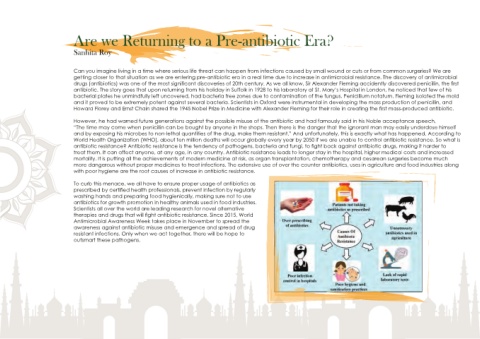
                           more dangerous without proper medicines to treat infections. The extensive use of over the counter antibiotics, uses in agriculture and food industries along
                           with poor hygiene are the root causes of increase in antibiotic resistance.

                           To curb this menace, we all have to ensure proper usage of antibiotics as
                           prescribed by certified health professionals, prevent infection by regularly
                           washing hands and preparing food hygienically, making sure not to use
                           antibiotics for growth promotion in healthy animals used in food industries.
                           Scientists all over the world are leading research for novel alternative
                           therapies and drugs that will fight antibiotic resistance. Since 2015, World
                           Antimicrobial Awareness Week takes place in November to spread the
                           awareness against antibiotic misuse and emergence and spread of drug
                           resistant infections. Only when we act together, there will be hope to
                           outsmart these pathogens.

