


Page 38 - TI Journal 18-1
P. 38
32                                      ZHANG


                       Tractography        Clustering
                                                                        Visualization
               Diffusion –
               Weighted            Diffusion           Fiber
                Images              Fibers            Bundles
                                                                           Metrics

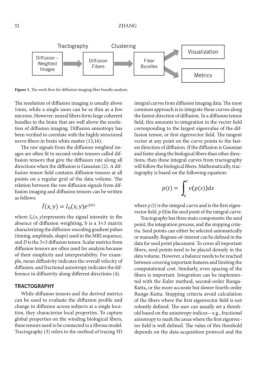
      Figure 1. The work flow for diffusion imaging fiber bundle analysis.


      The resolution of diffusion imaging is usually above   integral curves from diffusion imaging data. The most
      1mm, while a single axon can be as thin as a few   common approach is to integrate these curves along
      microns. However, neural fibers form large coherent   the fastest direction of diffusion. In a diffusion tensor
      bundles in the brain that are well above the resolu-  field, this amounts to integration in the vector field
      tion of diffusion imaging. Diffusion anisotropy has   corresponding to the largest eigenvalue of the dif-
      been verified to correlate with the highly structured   fusion tensor, or first eigenvector field. The tangent
      nerve fibers in brain white matter (13,16).   vector at any point on the curve points to the fast-
        The raw signals from the diffusion weighted im-   est direction of diffusion. If the diffusion is Gaussian
      ages are often fit to second-order tensors called dif-  and faster along the biological fibers than other direc-
      fusion tensors that give the diffusion rate along all   tions, then these integral curves from tractography
      directions when the diffusion is Gaussian (2). A dif-  will follow the biological fibers. Mathematically, trac-
      fusion tensor field contains diffusion tensors at all   tography is based on the following equation:
      points on a regular grid of the data volume. The
      relation between the raw diffusion signals from dif-
                                                                      �
      fusion imaging and diffusion tensors can be written     () =        �()�
      as follows:                                                      ₀
                 ~                                  where p (t) is the integral curve and is the first eigen-
                 (, ) = ₀(, ) ()
                                                    vector field. p (0)is the seed point of the integral curve.
      where I 0 (x, y)represents the signal intensity in the     Tractography has three main components: the seed
      absence of diffusion weighting, b is a 3×3 matrix   point, the integration process, and the stopping crite-
      characterizing the diffusion-encoding gradient pulses   ria. Seed points can either be selected automatically
      (timing, amplitude, shape) used in the MRI sequence,   or manually. Regions-of-interest can be defined in the
      and D is the 3×3 diffusion tensor. Scalar metrics from   data for seed point placement. To cover all important
      diffusion tensors are often used for analysis because   fibers, seed points need to be placed densely in the
      of their simplicity and interpretability. For exam-  data volume. However, a balance needs to be reached
      ple, mean diffusivity indicates the overall velocity of   between covering important features and limiting the
      diffusion, and fractional anisotropy indicates the dif-  computational cost. Similarly, even spacing of the
      ference in diffusivity along different directions (4).   fibers is important. Integration can be implemen-
                                                    ted with the Euler method, second-order Runga-
      TRACTOGRAPHY                                  Kutta, or the more accurate but slower fourth-order
        While diffusion tensors and the derived metrics   Runge-Kutta. Stopping criteria avoid calculation
      can be used to evaluate the diffusion profile and   of the fibers where the first eigenvector field is not
      change in diffusion across subjects at a single loca-  robustly defined. The user can usually set a thresh-
      tion, they characterize local properties. To capture   old based on the anisotropy indices—e.g., fractional
      global properties on the winding biological fibers,   anisotropy to mark the areas where the first eigenvec-
      these tensors need to be connected to a fibrous model.   tor field is well defined. The value of this threshold
      Tractography (3) refers to the method of tracing 3D   depends on the data-acquisition protocol and the

