


Page 41 - TI Journal 18-1
P. 41
DIFFUSION IMAGING FIBER BUNDLES                           35


          characteristics of a single fiber (e.g., the length, the   (Figure 2a right) or automatically selected with clus-
          average curvature, the average fractional anisotropy,   tering algorithms (Figure 2b). Geometric hulls (7)
          etc.). Metrics can also be applied to fiber bundles   can be wrapped around the boundary of the fiber
          which contain a group of fibers—e.g., the number of   bundles to better illustrate the shape and size of the
          fibers, the total length of all fibers, the total summed   fiber bundles (Figure 2c). Alternative methods have
          length of all fibers in the bundle after weighting each   been proposed, such as projecting the 3D curves to
          fiber by its average fractional anisotropy, etc. (9). The   2D points while preserving the similarities among
          fiber bundle metrics are likely influenced by brain   the fibers (Figure 2d) (6).
          size and, thus, may require further correction. The
          metrics can be normalized by the size of the brain,   HARDI FIBER BUNDLES
          or the intracranial volume, which may provide a bet-    As a model for diffusion imaging, diffusion tensor
          ter index of brain size prior to the impact of age and   has limitations. More than one fiber orientation (e.g.,
          pathology.                                   in crossing or kissing fibers) may exist within a single
                                                       imaging voxel, and simple diffusion tensor meth-
          VISUALIZATION                                ods are limited in the recovery of structures in areas
            Complementary to the quantitative metrics of   with complex intra-voxel heterogeneity. To address
          diffusion fiber bundles, visualization provides an intu-  this problem, high angular resolution diffusion imag-
          itive and direct means to explore these fiber bundles.   ing (HARDI) techniques were developed to resolve
          Diffusion fibers form complicated shapes in brain   local crossing fibers within a voxel. Using HARDI,
          white matter echoing the shapes of the neural fiber   the orientation distribution functions (ODF) for
          bundles. The challenge in visualization includes the   describing the diffusion profile allow multiple max-
          amount of fibers, the complexity of the fiber shapes,   ima and, thus, capture complex fiber structures, such
          and the multivariate nature of the tensor data. The   as crossing, kissing, merging, curving, and fanning
          3D diffusion fibers generated from the tractography   fibers.
          can be visualized with 3D curves, or streamtubes     HARDI-based tractography algorithms can be
          (23), that use cross section shape and color to map   classified as deterministic or probabilistic. Deter-
          additional tensor properties like the eigenvectors   ministic tracking methods such as streamlines (3)
          and anisotropy (Figure 2a left). Fiber bundles can   or variations of streamlines (15) in 3D are often
          be manually selected by setting regions-of-interests   used because of their efficient computation.


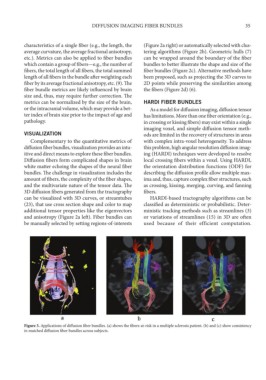
          Figure 3. Applications of diffusion fiber bundles. (a) shows the fibers-at-risk in a multiple sclerosis patient. (b) and (c) show consistency
          in matched diffusion fiber bundles across subjects.

