


Page 54 - T-I JOURNAL19 4
P. 54
702                                SEXTON & LIGLER


      the creation of a new technology, software, or research    This snapshot of patenting activity reveals that,
      tool to the TTO. The rate of submission of inven-  while we are seeing female students and staff engage
      tion disclosures by a particular research group can  in technology commercialization, there exists an
      therefore provide a useful proxy for measuring initial  urgent need to encourage more female faculty mem-
      engagement in the technology commercialization  bers to participate. Providing female faculty with
      process. Since nationwide data does not yet exist for  the experience and skill sets needed to navigate the
      the rate of invention disclosure by female inventors at  technology commercialization process will accelerate
      universities, we examined the data for our university,  the cycle that drives university innovation. Increased
      North Carolina State University (NC State). We found  participation by female faculty will also help to spur
      women have been included as contributors on only  a cultural shift whereby the participation of women
      15% of the invention disclosures submitted during  in the commercialization process becomes the rule
      the past two years although approximately 35% of  and not the exception. However, in order to design
      NC State faculty are women.                 effective programs to reach women faculty, the poten-
        The gap in reporting innovations inevitably trans-  tial causes behind their lower level of participation
      lates to actual patent activity as well. Nationwide,   first need to be identified.
      women were inventors on only 18.8% of U.S. patents
      issued in 2010 (4). Of the U.S. utility patents issued   POSSIBLE FACTORS BEHIND THE GENDER
      to NC State in 2015 and 2016, 30% included one or   PATENT GAP
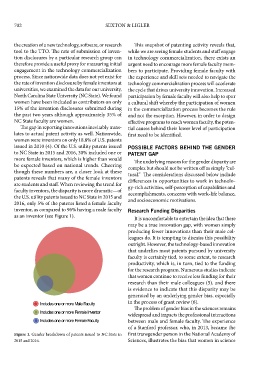
      more female inventors, which is higher than would     The underlying reasons for the gender disparity are
      be expected based on national trends. Cheering   complex but should not be written off as simply “cul-
      though these numbers are, a closer look at these   tural.”  The considerations discussed below include
      patents reveals that many of the female inventors   differences in opportunities to work in technolo-
      are students and staff. When reviewing the trend for   gy-rich activities, self-perception of capabilities and
      faculty inventors, the disparity is more dramatic—of   accomplishments, concerns with work-life balance,
      the U.S. utility patents issued to NC State in 2015 and   and socioeconomic motivations.
      2016, only 5% of the patents listed a female faculty
      inventor, as compared to 96% having a male faculty   Research Funding Disparities
      as an inventor (see Figure 1).                It is uncomfortable to entertain the idea that there
                                                  may be a true innovation gap, with women simply
                                                  producing fewer innovations than their male col-
                                                  leagues do. It is tempting to dismiss this possibility
                                                  outright. However, the technology-based innovation
                                                  that underlies most patents pursued by university
                                                  faculty is certainly tied, to some extent, to research
                                                  productivity, which is, in turn, tied to the funding
                                                  for the research program. Numerous studies indicate
                                                  that women continue to receive less funding for their
                                                  research than their male colleagues (5), and there
                                                  is evidence to indicate that this disparity may be
                                                  generated by an underlying gender bias, especially
                                                  in the process of grant review (6).
                Includes one or more Male Faculty
                                                    The problem of gender bias in the sciences remains
                Includes one or more Female Inventor
                                                  widespread and impacts the professional interactions
                Includes one or more Female Faculty  between male and female faculty. The experience
                                                  of a Stanford professor, who, in 2013, became the
      Figure 1. Gender breakdown of patents issued to NC State in   first transgender person in the National Academy of
      2015 and 2016.                              Sciences, illustrates the bias that women in science

