


Page 90 - T-I JOURNAL19 4
P. 90
738                                  COUCH ET AL.


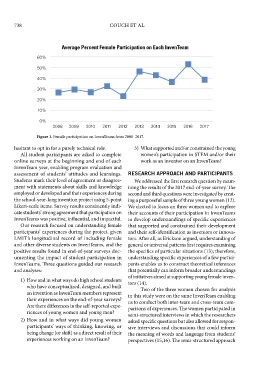
                        Average Percent Female Participation on Each InvenTeam

               60%

               50%
               40%
               30%

               20%

               10%
                0%
                     2008  2009   2010  2011  2012  2013  2014  2015   2016  2017

               Figure 1. Female participation on InvenTeams from 2008–2017.
      hesitant to opt in for a purely technical role.   3)  What supported and/or constrained the young
        All student participants are asked to complete     women’s participation in STEM and/or their
      online surveys at the beginning and end of each     work as an inventor on an InvenTeam?
      InvenTeam year, enabling program evaluation and
      assessment of students’ attitudes and learnings.  RESEARCH APPROACH AND PARTICIPANTS
      Students mark their level of agreement or disagree-    We addressed the first research question by exam-
      ment with statements about skills and knowledge  ining the results of the 2017 end-of-year survey. The
      employed or developed and their experiences during  second and third questions were investigated by creat-
      the school-year-long invention project using 5-point  ing a purposeful sample of three young women (12).
      Likert-scale items. Survey results consistently indi-  We elected to focus on three women and to explore
      cate students’ strong agreement that participation on  their accounts of their participation in InvenTeams
      InvenTeams was positive, influential, and impactful.  to develop understandings of specific experiences
        Our research focused on understanding female  that supported and constrained their development
      participants’ experiences during the project, given  and their self-identification as inventors or innova-
      LMIT’s longitudinal record of including female  tors. After all, as Erickson argued, understanding of
      and other diverse students on InvenTeams, and the  general or universal patterns first requires examining
      positive results found in end-of-year surveys doc-  the specifics of particular situations (13); therefore,
      umenting the impact of student participation in  understanding specific experiences of a few partici-
      InvenTeams. Three questions guided our research  pants enables us to construct theoretical inferences
      and analyses:                               that potentially can inform broader understandings
                                                  of initiatives aimed at supporting young female inven-
         1)  How and in what ways do high school students    tors (14).
           who have conceptualized, designed, and built       Two of the three women chosen for analysis
           an invention as InvenTeam members represent    in this study were on the same InvenTeam enabling
           their experiences on the end-of-year surveys?    us to conduct both inter-team and cross-team com-
           Are there differences in the self-reported expe-   parisons of experiences. The women participated in
           riences of young women and young men?   semi-structured interviews in which the researchers
         2) How and in what ways did young women    asked specific questions but also allowed for respon-
           participants’ ways of thinking, knowing, or    sive interviews and discussions that could inform
           being change (or shift) as a direct result of their    the meaning of words and language from students’
           experiences working on an InvenTeam?   perspectives (15,16). The semi-structured approach

