


Page 88 - T-I JOURNAL19 4
P. 88
736                                  COUCH ET AL.                                                                                       ADDRESSING THE GENDER GAP                           737


         Prior studies have identified a wide range of factors  to invent while in high school, with an emphasis on   Table 1. Summary of the Phases of an InvenTeam Grant Cycle
      that contribute to the differences between men’s and  policy considerations that are particularly important           Phase              Duration
      women’s success in obtaining patents, including the  for supporting the development of female inventors.    Phase   Description  Months  in weeks            Activities             Milestone
      social organization of scientists’ work settings (6,7);  The study is grounded in an understanding of invent-  Teacher-focused phases
      the expense of the patenting process (6); the need  ing and in ways of thinking as an inventor, as detailed
      for legal representation and access to lawyers (3,6);  in a 2004 report issued by the Committee for the       1   Recruitment for  Oct.–Apr.  24  Application requires invention proposal,  April deadline
      patenting behaviors of a parent (8,2); the effects of  Study of Invention (10). We selected InvenTeams™,          and submissions                information on school, resumés of teachers,
      exposure, such as growing up (or not) in areas that  the national initiative of the Lemelson-MIT (LMIT)           of initial                     letter of support from administrator, and
      have innovative companies and universities (2); and  Program, as our site of study because the program’s          applications for               statement of interest for invention projects
      personal factors such as access to mentors (or social  founder was a prolific inventor, its current faculty       Excite Award
      networks), family income, and race (2,6). Lack of  director is a prolific inventor, and because the pro-      2   Finalists’     Mid-Apr.   2    LMIT evaluation of educator’s applications  35 educators
      representation by women among degree holders in  gram has a sustained fourteen-year history of helping            selection by                   utilizing rubric                 receive Excite
      science, technology, engineering, and mathematics  high school students from diverse backgrounds (gen-            LMIT staff                                                      Award to attend
      (STEM) fields has also been identified as a factor  der and race) develop working prototypes of their                                                                             EurekaFest
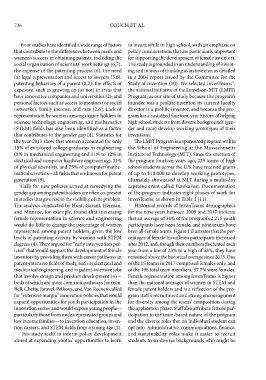
      that contributes to the gender gap (4). Statistics for  inventions.                                           3   Professional   Mid-Jun.   1    Excite Award recipients attend professional Invitation to
      the year 2013 show that women accounted for only    The LMIT Program is a sponsored program within                development                    development during EurekaFest at MIT,  Excite Awardees
      15% of employed college graduates in engineering  the School of Engineering at the Massachusetts                                                 view current year’s projects, receive feed-  to submit final
      (8% in mechanical engineering and 11% to 12% in  Institute of Technology (MIT). Since the creation of                                            back on proposed projects, and review  application if
      electrical and computer hardware engineering), 31%  the program fourteen years ago, 229 teams of high                                            guidelines for the final application  they attended
      of physical scientists, and 25% of computer/mathe-  school students across the U.S. have received grants                                                                          Eureka Fest
      matical scientists—all fields that are known for patent  of up to $10,000 to develop working prototypes,
      generation (9).                             ultimately showcased at MIT during a multi-day                    4   Summer work   Jul.–Sept.  8    Excite Award recipients work with students Final
        Calls for new policies aimed at remedying the   capstone event called EurekaFest. Documentation                 with students                  to form teams and complete the final  applications
      gender gap among patent holders are often co-present  of the program indicates eight phases of work for                                          InvenTeam application            submitted
      in studies that give rise to the visibility of the problem.  InvenTeams, as shown in Table 1 (11).            5   Judging         Sept.     4    National jury review and ranking of  15 teams
      The analysis conducted by Hunt, Garant, Herman,    Historical records of InvenTeams demographics                                                 applications, and recommendations to  selected for
      and Munroe, for example, found that increasing  for the nine years between 2008 and 2017 indicate                                                LMIT for staff to make final selection  $10,000
      female representation in science and engineering  that an average of 34% of the program’s 2,215 youth                                                                             InvenTeam
      would do little to change the percentage of women  participants have been female, and nine teams have                                                                             grants and
      represented among patent holders, given the low  been all-female teams. Figure 1 illustrates that the per-                                                                        notified
      levels of patenting activity by women with STEM  centages of female InvenTeam participants increased
      degrees (4). They argued for “early intervention pol-  after 2012, and, though their numbers fluctuated each   Team-focused phases with teachers, mentors, and students
      icies” that would support the development of female  year from a low of 23% to a high of 53%, they have       6    Invention project Oct.–Feb.  20  Grant agreements signed, procurement  Mid-grant
      inventors by providing them with career pathways in  remained above the historical average since 2013. One         launch                        cards released, communications and  technical review
      patent-intensive fields of study, such as electrical and  of the 15 teams in 2017 comprised females only, and                                    financial training for teams, on-site visits  with community
      mechanical engineering, and in patent-intensive jobs  of the 196 total team members, 37.7% were females.                                         from LMIT while teams iteratively build,  in February
      that involve design and product development (4)—  Female representation among InvenTeams is higher                                               test, and refine invention prototypes based
      both of which are more common pathways for men.  than the national averages of women in STEM and                                                 on results and feedback, and beginning-of-
      Bell, Chetty, Jaravel, Petkova, and Van Reenen called  female patent holders and is a reflection of the pro-                                     year survey
      for “extensive margin” innovation policies that would  gram staff’s recruitment and strong encouragement
      expand opportunities for youth participation in the  for diversity among the teams’ composition during        7    Post-technical  Mar.–Jun.  12  Final invention modifications and prototype  Working
      innovation sector and would expose young people—  the application phase. Staff also attribute female par-          review                        building, raise travel funds to attend   prototype
      particularly those from underrepresented groups and  ticipation to the team-based nature of the program                                          Eureka Fest at MIT, and end-of-year survey  shipped to MIT
      low income families—to invention education, inven-  and the diverse roles that an individual student can      8    Capstone event  Mid-Jun.  1   Team travels to MIT, showcase inventions,  EurekaFest
      tion careers, and STEM fields from a young age (2).  opt into. Administrative, communications, finance,                                          present to peers, meet collegiate inventors,
         This study seeks to inform policy development  and sustainability roles make it easier to recruit                                             and attend seminars
      aimed at expanding youths’ opportunities to learn  students from diverse backgrounds who might be

