


Page 18 - T-I JOURNAL19-3
P. 18
578                                CRAWFORD ET AL.


      link the quantity and quality of its STEM graduates    As an innovator in STEM education programs, The
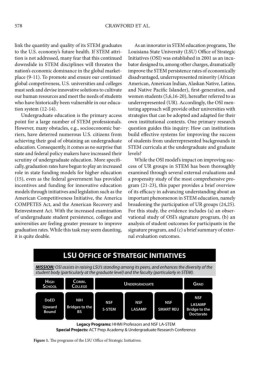
      to the U.S. economy’s future health. If STEM attri-  Louisiana State University (LSU) Office of Strategic
      tion is not addressed, many fear that this continued  Initiatives (OSI) was established in 2001 as an incu-
      downslide in STEM disciplines will threaten the  bator designed to, among other charges, dramatically
      nation’s economic dominance in the global market-  improve the STEM persistence rates of economically
      place (9-11). To promote and ensure our continued  disadvantaged, underrepresented minority (African
      global competiveness, U.S. universities and colleges  American, American Indian, Alaskan Native, Latino,
      must seek and devise innovative solutions to cultivate  and Native Pacific Islander), first-generation, and
      our human resources and meet the needs of students  women students (5,6,16-20), hereafter referred to as
      who have historically been vulnerable in our educa-  underrepresented (UR). Accordingly, the OSI men-
      tion system (12-14).                        toring approach will provide other universities with
        Undergraduate education is the primary access  strategies that can be adopted and adapted for their
      point for a large number of STEM professionals.  own institutional contexts. One primary research
      However, many obstacles, e.g., socioeconomic bar-  question guides this inquiry: How can institutions
      riers, have deterred numerous U.S. citizens from  build effective systems for improving the success
      achieving their goal of obtaining an undergraduate  of students from underrepresented backgrounds in
      education. Consequently, it comes as no surprise that  STEM curricula at the undergraduate and graduate
      state and federal policy makers have increased their  levels?
      scrutiny of undergraduate education. More specifi-    While the OSI model’s impact on improving suc-
      cally, graduation rates have begun to play an increased  cess of UR groups in STEM has been thoroughly
      role in state funding models for higher education  examined through several external evaluations and
      (15), even as the federal government has provided  a propensity study of the most comprehensive pro-
      incentives and funding for innovative education  gram (21-23), this paper provides a brief overview
      models through initiatives and legislation such as the  of its efficacy in advancing understanding about an
      American Competitiveness Initiative, the America  important phenomenon in STEM education, namely
      COMPETES Act, and the American Recovery and  broadening the participation of UR groups (24,25).
      Reinvestment Act. With the increased examination  For this study, the evidence includes (a) an obser-
      of undergraduate student persistence, colleges and  vational study of OSI’s signature program, (b) an
      universities are feeling greater pressure to improve  analysis of student outcomes for participants in the
      graduation rates. While this task may seem daunting,  signature program, and (c) a brief summary of exter-
      it is quite doable.                         nal evaluation outcomes.


                         LSU OFFICE OF STRATEGIC INITIATIVES

              MISSION: OSI assists in raising LSU’s standing among its peers, and enhances the diversity of the
              student body (particularly at the graduate level) and the faculty (particularly in STEM).
                  HIGH       COMM.              UNDERGRADUATE             GRAD
                 SCHOOL     COLLEGE

                                                                           NSF
                  DoED        NIH        NSF        NSF         NSF
                                                                         LASAMP
                 Upward   Bridges to the  S-STEM   LASAMP    SMART REU  Bridge to the
                 Bound        BS                                         Doctorate
                              Legacy Programs: HHMI Professors and NSF LA-STEM
                      Special Projects: ACT Prep Academy & Undergraduate Research Conference
              Figure 1. The programs of the LSU Office of Strategic Initiatives.

