


Page 20 - T-I JOURNAL19-3
P. 20
curricular  approach  that  integrates  metacognitive  and  active  learning strategies as well as
        early interventions and career opportunities into a series of professional  development
        courses ; 3) individualized faculty, staff, and peer mentoring; and 4) domestic and international
        undergraduate research opportunities. These four approaches have been implemented through
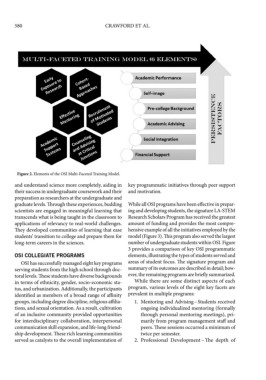
        employing six elements outlined in Figure 2.
      580                                CRAWFORD ET AL.


       Figure 2. Elements of the OSI Multi-Faceted Training Model.
        Figure 2. Elements of the OSI Multi-Faceted Training Model.
      and understand science more completely, aiding in  key programmatic initiatives through peer support

      their success in undergraduate coursework and their  and motivation.
      preparation as researchers at the undergraduate and
               Within the OSI Training Model, undergraduate participants were taught the fundamental
      graduate levels. Through these experiences, budding  While all OSI programs have been effective in prepar-
      scientists are engaged in meaningful learning that  ing and developing students, the signature LA-STEM
        principles of positive mindset development, mentoring, metacognitive learning, and research
      transcends what is being taught in the classroom to  Research Scholars Program has received the greatest
      applications of relevancy to real-world challenges.  amount of funding and provides the most compre-
        through training classes and interactions with their peers, graduate students, high school students,
      They developed communities of learning that ease  hensive example of all the initiatives employed by the
      students’ transition to college and prepare them for  model (Figure 3). This program also served the largest
        program staff, and faculty at the college, high school, and elementary school levels.  Using this
      long-term careers in the sciences.          number of undergraduate students within OSI. Figure
                                                  3 provides a comparison of key OSI programmatic
        mentoring approach, mentees are guided in developing the metacognitive tools and strategies
      OSI COLLEGIATE PROGRAMS                     elements, illustrating the types of students served and
        OSI has successfully managed eight key programs   areas of student focus. The signature program and
      serving students from the high school through doc-  summary of its outcomes are described in detail; how-
      toral levels. These students have diverse backgrounds   ever, the remaining programs are briefly summarized.
      in terms of ethnicity, gender, socio-economic sta-    While there are some distinct aspects of each
      tus, and urbanization. Additionally, the participants   program, various levels of the eight key facets are
      identified as members of a broad range of affinity   prevalent in multiple programs:
      groups, including degree discipline, religious affilia-  1.  Mentoring and Advising – Students received
      tions, and sexual orientation. As a result, cultivation   ongoing individualized mentoring (formally
      of an inclusive community provided opportunities   through personal mentoring meetings), pri-
      for interdisciplinary collaboration, interpersonal   marily from program management staff and
      communication skill expansion, and life-long friend-  peers. These sessions occurred a minimum of
      ship development. These rich learning communities   twice per semester.
      served as catalysts to the overall implementation of   2.  Professional Development – The depth of

